
Monday, May 31, 2010

A FAMILY RAISED ON SUNSHINE

One of the great joys of life for Shirley and myself, is the close connection we feel with three generations of our offspring. We think of this in a special way as we go about the chores associated with stocking our shelves, making out shopping lists, and savoring the good things of life that come from garden, greenhouse, pantry or root cellar to grace our daily table. Our extended family live away from us except for celebrative get-togethers, but we talk to one or another of them daily.
The subjects of these phone and e-mail conversations are wide-ranging, but one thing comes up with heart-warming regularity: “Grandpa, how do you go about creating a roux for that New Orleans Gumbo of yours” asks a granddaughter in Colorado ? “Mom, how do you get your chocolate chip cookies so crispy yet tender at the same time ?” “Priya wants to know if Grandpa will be making black bean soup when we visit you” asks the mother of a five-year old great–granddaughter many miles away. “ Tell mother my latest whole wheat bread came out looking just like hers”, reports a daughter trying a new combination of flours. Or. . . “Will you two be making corn relish this year ? Will you let us know so that we can come down and learn how you do it ? By the way. . . we are all out ! Do you have an extra jar ?”
And when we do get together as a family, regardless of occasion, we end up at the now-extended dinner table where life-long memories are rekindled by a menu filled with the history we have shared as a family over a fifty-six year span. (So far.)
In an honored corner of our pantry book shelf resides a small cookbook written and self-published more than three decades ago by a friend and former neighbor of ours back in the mid-west. Beverly Nye’s recipes are great, but what has long endeared her book to us is the title she gave it: A FAMILY RAISED ON SUNSHINE.
Bev’s book is not just a collection of time-tested recipes assembled by a devoted wife, mother and home cook, but a celebration of the threads of everyday love bound up in the humble art of home-making and family-keeping.
I mention all of this because at a time when all is not well across the country with our economic challenges, and the prospect of higher fuel, food and living costs, there is something of an incipient renaissance going on. Many people are beginning to rethink our high-consumption / high -dependency lifestyle, and wondering if maybe grandma and grandpa knew something after all. Perhaps being able to do more with less is worth thinking about. Perhaps there is a silver lining to having to stay home more, travel less, watch our dollars more closely and be more creative and frugal in meal-planning and table-keeping.
Recent statistics tell us that the average American family eats 38% of its meals away from home while depending heavily upon “convenience” ingredients with a short shelf life and a high cost for the meals that are prepared at home. There are many who would argue that our modern-day dependency upon the very technologies which promised to simplify day-to-day family life may actually make us more vulnerable to economic swings and temporary set-backs than any previous generation. It’s worth thinking about.
When all is said and done, whether it rains or doesn’t, the two of us continue to cook and bake and home-preserve together, (and answer the phone when it rings ), encouraged by the idea that the best pay-off of all is to have a family raised on sunshine.
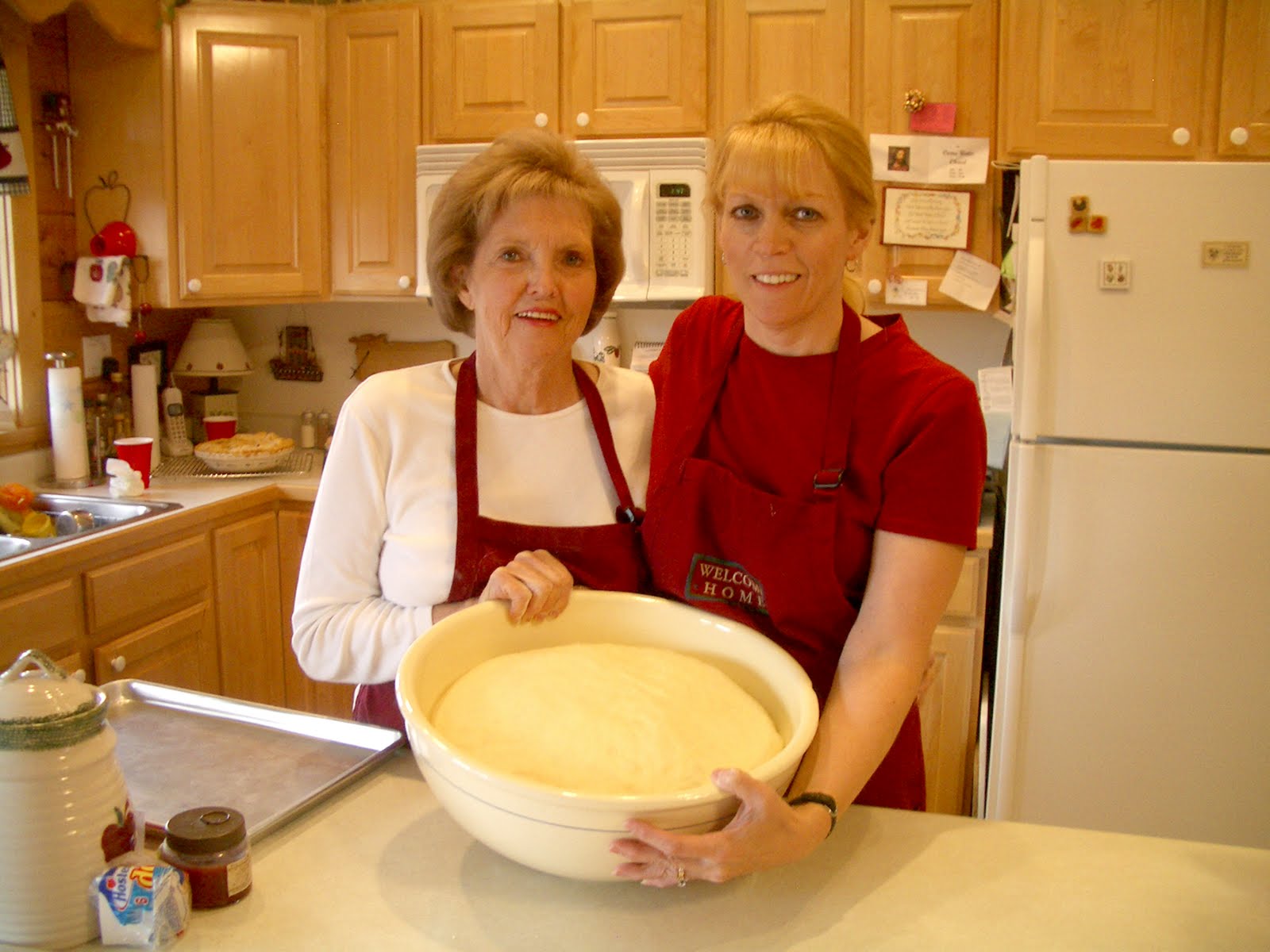

Shirley and daughter Shayne mix up a batch of yeast-based dinner rolls – a family favorite.

Al teaches two great grandchildren the fine art of making whole wheat-yogurt-blueberry pancakes.

Saturday, May 22, 2010

ROOM 40 THE MESSAGE THAT CHANGED HISTORY

Within five hours of England’s declaration of war on August 14th, 1914, the British cable ship Teleconia dragged its grappling hooks across the sea bottom at a strategic point in the North Sea, raising then cutting Germany’s deep sea cable running from Borkum to Spanish Tenerife in the Canary Islands. The order had come directly from First Sea Lord Winston Churchill, and was destined to begin a chain of events which could not have been foreseen at that moment.
On the 26th of that same August, the German cruiser Magdeburg ran aground off the Estonian coast where it was seized by the Russians. Several copies of a book containing the German Naval codes were also seized, and two of these books were shared with the British. Those books found their way to the Admiralty’s intelligence service, where they were quickly relayed to “Room 40”, an actual office address which would ultimately become a euphemism for the top secret group of cryptographers whose job was decoding enemy messages – an operation which presaged the “ULTRA” system which helped to win WW II for the Allies. The occupants of “Room 40” already possessed a copy of Germany’s “Office Codes”, lifted from a sunken U-boat early in the war which, when linked with Russia’s contribution to their “library of secrets” – would bring about a revelation of historic consequence.
The occupants of “Room 40” consisted of an unusual blend of wizards, from mathematicians to linguists, who – together – represented the world’s first glimpse of what would grow into computer science. In 1914-17 they were a mere handful, unlike the hundreds like them who in World War II would occupy a former girls’ school at England’s Bletchley Park.
In the United States, public sympathies lay largely with the “Allied Nations” in their expanding war with Germany and the “Central Powers”. Despite the sinking of the RMS Lusitania, and the loss of 128 American lives in May, 1915, and the infamous “Black Tom” sabotage incident of July 30, 1916 (*), the mood across the U.S. did not favor involvement in what was viewed as “Europe’s War”. Although Woodrow Wilson – a Democrat “Progressive”- held different views, he was locked in a tight campaign for the presidency with Supreme Court Justice John Evans Hughes, and ran on an anti-war platform. Wilson won the presidency by an extremely slender margin in November, 1916, by promising American mothers their sons would not be drawn into a foreign war.
As Germany prepared to move toward a more aggressive use of submarine warfare in its blockade of aid shipments to England, American intervention seemed more and more likely to the Kaiser’s military planners. So in January, 1917, the Foreign Minister, Arthur Zimmermann authored a secret document suggesting that Mexico declare its alliance with the Central Powers in the event the U.S. entered the war. It was further suggested, that in return for this action, a victorious Germany would see to it that the states of Texas, New Mexico and Arizona would be returned to Mexico. Because Germany’s undersea cables had been cut early in the war, it was necessary for Zimmermann’s coded message to be sent in the form of a telegram. The telegram was intercepted by British Intelligence where the missile was promptly turned over to the occupants of “Room 40”. Because the German Office and Naval codes had been “broken” by England’s cryptologists, the contents of the message were quickly translated and forwarded to U.S. authorities.
On March 1st, 1917, the “Zimmermann telegram” became national headlines, infuriating the American public. On top of Lusitania, and the “Black Tom” incident, it became the “straw that broke the camel’s back” (and played right into Woodrow Wilson’s hand).
On April 6th, 1917, the United States declared war, and American “doughboys” would soon be on their way to the trenches of France.

(*) “Black Tom” was the name of an island in New York Harbor, associated with Jersey City, New Jersey. In 1916-17 the built-up island and its mile-long pier became a loading platform for munitions ready for shipment across the Atlantic. In the early morning hours of July 30th, 1916, a tremendous explosion measuring 5.5 on the Richter scale shook the eastern seaboard, breaking windows 40 miles away, and imbedding shrapnel in the nearby Statue of Liberty, so damaging the structure that to this day, it is unsafe to enter the monument’s raised arm. The “Black Tom” explosion killed at least seven, injured many others, and did millions of dollars in damage. It was deemed to be the work of a small group of German saboteurs, and stirred strong anti-German sentiment.
Interestingly, an international commission eventually assigned a penalty of $50 million 1953 dollars, the final payment of which was paid to the U.S. by Germany in 1979.

THE BATTLE OF TANGA Britain’s Most Stinging Defeat


One of the most innovative guerilla commanders of all time, General Paul Emil von Lettow-Vorbeck invented camouflage, led herds of cattle to feed his army, and tended his native troops with natural herbs and remedies. He never suffered defeat.

A map of the African Continent and its constituent parts as it would have appeared in the opening decades of the 20th century would be seen to bear very little resemblance to the Africa we see today. It had been largely “carved up” into colonies claimed and administered by most of the major European powers. France, Britain, Germany, Italy, Portugal, Belgium and Spain all had their names circumscribed over various pieces of the huge landmass. From The Belgian Congo to Italian Somaliland, the map looked more like a piece of patterned linoleum with international names for the titles of its random subdivisions.
As Europe moved toward World War I, with more than 24 countries declaring sides by 1914, Africa became a piece of that military and political chessboard. To the British it seemed like a good time to make territorial gains by launching an invasion into German East Africa, a land immediately adjacent to their own Kenya (British East Africa). Under the command of General Arthur Aitkin, an 8000 man force made up of both British and Indian troops went ashore on the evening of November 3, 1914 to assault the town of Tanga, a seaport outpost only about 50 miles from the border, defended at the time by only two companies of Germans.
Although he would ultimately outnumber his adversary by an eight to one margin, what Aitkin did not realize was that he was about to come up against one of the most amazing field commanders in military history in the person of Paul von Lettow-Vorbeck.
Trained in the proud Prussian tradition and descended from an old military family, Lettow-Vorbeck had assembled and trained a force of African natives, known as askaris, around a core of only a handful of white German officers and non-com’s. Previous to the upcoming battle, he had kidnapped the sitting German territorial governor in order to keep him from surrendering to the invading British.
From the outset, the British effort was fraught with bad luck. First what should have been a surprise attack was given away by the untimely firing of gunboat cannons, followed by the deployment of the attacking force into swampy terrain in the absence of any advance reconnoitering, ending in disorderly and undisciplined formations. Although the Germans never had more than 1000 troops in the fight, they quickly sent Aitkin’s faltering attackers back toward their boats. Then, to add insult to injury, they ran into squadrons of enraged African bees which attacked the retreating troops unmercifully.
The ill-fated attack on Tanga would forever after be known as “The Battle of the Bee’s”, and a legend would spring up suggesting that the German commander had planted the wild bee colonies as part of his strategy.
The story of this one battle barely scratches the surface of the much larger story of the exploits of Paul von Lettow-Vorbeck himself, who without any support from, or even communications with the German high command at home, managed continuously to fight vastly superior forces arrayed against him, without a single defeat for four years. All of this while living off the land as they went, surviving by their wits and local knowledge. At one time, his small but dedicated band faced an army of 45,000 fresh South African soldiers who, time after time failed to extract a victory from their best attempts to encircle him. In all, 130 generals and 300,000 men took the field against him in the course of the war, without ever winning a battle.
The native askari men who soldiered under the German guerilla leader loved him like a father, and he treated them the same way. He lived daily life among them, and led them personally in every engagement, sometimes riding a bicycle into battle to their absolute delight. While scoring an excruciatingly high cost in casualties on the part of his enemies, he managed always to protect his own men from suffering in kind. Rather than burdening his own small force with the need of caring for prisoners, he routinely placed POWs under an oath to renounce fighting in return for a battlefield parole.
Only after successfully taking possession of British territory in Rhodesia (the only time this ever took place in WW I), in November, 1918, did the German Commander learn from a prisoner that an armistice had been signed between the warring parties. Obliged by his honor as a German officer to comply, he ended his war by disbanding his force on November 23rd, 1918 – still undefeated.
General Paul von Lettow-Vorbeck passed away in Hamburg, Germany, on March 9th, 1964 at the age of 94. Ironically he would have died penniless but for a small pension granted to him thanks to an old enemy, Jan Christiaan Smuts of South Africa.

Saturday, May 1, 2010

ICE SKATES AND THE LONG YELLOW BUS

One of my favorite light houses is perched on a tiny nubble of rocky land which becomes an island at high tide, but is loosely connected to the equally-rocky shoreline for a few slippery hours each day when the tide is out. For generations, Maine’s “Nubble Light” was a family light station, and children grew up in the white-painted bungalow which shares the two or three acres of grassy landscape with the light and its red-painted oil house. Some long-ago family constructed a cable and breeches buoy connecting the island to the mainland, some two hundred yards away, so that children could safely negotiate the cauldron-like moat which isolated them, facilitating thereby travel to and from school in nearby York. Though today an automated light, the last I knew the cable car was still there.
Other island families I know of – including several from whom I am descended – welcomed winter, so that their children could skate across the iced-over bays, reaches and inlets, saving them the cost of having to “board-out” their kids to mainland families during the school year.
For most rural school kids, well into the 1940s, the long walk to school was a part of everyday life, and what’s more, the first boy to arrive at the old one-room school in West Brookfield, Vermont was expected to split enough wood for the day, and fill the wood box behind the big round stove that sat in the middle of the room. I know, because my younger brother often got that job while I was off to a much more remote school destination which was seven miles away.
The town of Quincy, Massachusetts really started something when, back in 1869, they decided to provide a horse-drawn “school wagon” in an effort to improve attendance at village schools. The idea was soon copied by others, and some of those early school wagons became impressively elaborate, with canvas-covered roofs, and side curtains which could be lowered in inclement weather. Even the driver got to sit on an enclosed perch, perhaps the better to deal with over-active passengers – probably with no more success than his modern-day counterpart. In fact drivers soon learned that the noise of children climbing aboard was troubling to the horses, leading to a coach design with a rear entry door, a feature which continued into the automotive age.
By 1920 there were a small handful of school districts around the country which put model-T based truck chassis to work as school coaches, one of which I know is still used by an automotive museum to carry patrons between outdoor exhibits. In the years which followed, other communities followed, utilizing everything from refurbished circus vehicles to converted delivery vans, painted in every imaginable color. A patriotic red-white-and-blue color scheme seems to have been very popular. It was not until 1939 that a national color standard was agreed to by every state, and the “long yellow bus” was born. Unlike the U.S. and Canada, most other countries which provide some degree of school transportation are not hung up on colors, and school coaches look pretty much like public transportation vehicles. In Hong Cong such vehicles are much smaller, and are known as “Nanny Vans” !
People who get their kicks keeping records for almost everything claim that 475,000 long yellow buses shuffle 25 million kids each day to and from American schools. That works out to something like ten billion student trips per year, in a nation which is unique in giving each driver the power to stop other traffic in both directions at each stop.
With the ubiquitous yellow buses a common sight wherever one travels nowadays, there is something particularly charming about the mule-drawn sleds crowded with Amish school children which can now and then still be seen making their way across a snow-covered winter landscape in rural Pennsylvania. Where – by the way – the one-room school house is also still alive and well. I will have to check though to find out if there are still a few fiercely hardy and independent island kids around Casco Bay who still get to make the journey on ice skates. Probably not allowed.


We don’t know where old yellow school buses usually go to die, but Al Cooper found this one, doubtless crowded with old memories, languishing away in an overgrown Utah hay field.


Al's Great Granddaughter looks forward to riding to and from her school each day on a modern day long yellow school bus!

Sunday, April 25, 2010

A PLACE WHERE THE LOBSTER IS KING A Landlubber’s Lament

I am at that stage of life when it is perfectly excusable to indulge oneself by living in a dream world from time to time; a place where even the impossible can come true. For me such times usually occur at two AM in the morning, to an accompaniment of Tevye the milkman singing “If I Were a Rich Man”. And I start thinking . . .
If I were a rich man, I would own a boat. Not just any boat. Not even the usual “boat”. It would have to be a ‘Down East’ lobster boat; a 34-footer would be about right. And it would have to be a Beals Island type, with a classic cedar “carvel” plank hull, built up on a white oak back bone, with steam-bent frames of locust wood, and an extended deck house just long enough to enclose a small living space for overnight cruising. It would be nice if it had an up-to-date diesel power plant, oh, a Perkins or better yet a Caterpillar would do nicely. It would have to be a 1970s vintage, and originally built by one of the Beals or Alleys themselves, or, in a pinch, a “glassed-over” rebuild of one. I would keep her moored in New Harbor, where my friend Merle Thompson could keep her ship-shape and runnin’ smooth for when I could get back to the mid-coast two or three times a year. (It’s a long way to coastal Maine from Zion.)

“Sleepless Nights” captures the worries of a young lobsterman hoping for a good season in order to make payments on his first boat.

Of course, it goes without saying that even though no longer a full time “working boat”, it should have a hydraulic trap hoist and all the appropriate fittings so that I could pull a few well-placed lobster traps when the need arose; on the right side if you please. You see, I not only love lobster boats, the folks who cherish and operate them, and the waters they ply, but that pincer-snapping crustacean which gives purpose to the whole enterprise. After all, my favorite soup is lobster chowder, my number one sandwich is an over-stuffed lobster-meat roll, and a deep-dish, double-crust lobster pie gives new meaning to the word sumptuous.

“Pandora”s two-man crew loads up with bait and supplies at a Boothbay Harbor wharf.

Some time around 1773, Manwaring Beal settled on the island which became “Beals Island”, just a stones’ throw away from the present town of Jonesport, in the upper mid-coast of Maine. He was joined by Captain John Alley soon after, and it was here, and among their direct descendants that a legend was born and nourished. The graceful lines of what would become one of the most sea-worthy and practical working boats of the northeast, from the upward shear of their bow, to the low gunwale of the main deck can be traced to the proud ancestry of that time and place.
To this day, ownership of a “Beals Island” lobster boat and its offspring speaks eloquently of a love affair which continues to touch the lives of whole new generations of those who go down to the sea where the lobster is king.

“Red Lady II” displays the graceful lines of a “back bay” lobsterman. Nowadays, most working boats have long-lasting fiberglass hulls built out of molds duplicating two-hundred-year-old wooden boats.


Like their “cowboy” cousins of the West, fishermen of the Northeast are themselves cut from a patriotic mold.

Sunday, April 18, 2010

HISTORY, HORSES and HIGHWAYS


The Taftsville covered bridge over the Ottaquechee River, near the village of Woodstock is one of Vermont’s oldest. Built by Salmond Emmons III in 1836, it features an unusual combination of Kingpost trusses and a central arch. In its historic heyday, it probably registered the passing of hundreds of horse-drawn wagons every day. It continues to serve nearly 175 years later.

HISTORY, HORSES and HIGHWAYS
Why We Drive on the Right

It is assumed by many visitors to New England, that the purpose of covered bridges was to negate the need for removing snow from the roadway in winter. It comes as a surprise when a native to the area explains that the very opposite was true; that it actually became necessary to shovel snow onto the protected roadway, in order for horse-drawn sleds to negotiate the tunnel-like structure during the winter months. Talented builders designed and built with a ship-builder’s craftsmanship, and an eye for the future in mind. Roofed over and closed in, the ruggedly-arched edifice was protected from the elements year-round.
Over the years I have visited, photographed, and savored the history of more than one hundred of these structures for which I feel an almost spiritual connection. Some of my favorites were built in the period between the 1830s and 1880s, some with weathered signs which still warn “Please Walk Your Horses”, or “Speed Limit 10 mph”. (I should mention that some of them are haunted !)
It is always interesting to note the extent to which our present-day transportation network serves to remind us of the lasting impact of original “horse-power”. The standard gauge of America’s railroads for instance finds tracks divided by four feet, eight-and-one-half inches, the same as the first horse-drawn trolleys. That dimension was brought to our shores by British colonists who followed the Stephenson design which, some say, started with the wagon ruts left behind by Roman coaches drawn by War Horses whose double hitch determined axle design.
The landscape of England is littered with evidence of the long Roman occupation, beginning with Hadrian’s Wall, and including venerable canals and beautifully-engineered stone aqueducts, and even the routes followed by modern motorways. Some historians even believe that Britons’ odd habit of driving on the left side of the road may be anchored in that same history. Most Roman soldiers were right-handed, and so carried their swords on their left side. They would have wished to protect the scabbard by passing to the left of oncoming traffic – both mounted and afoot – while having unobstructed vision on their right. This preference appears to be borne out by studies of ancient wheel ruts at a stone quarry site near Rome.
Why then did America’s English settlers decide to drive on the right ? One answer is that after 1776, they wanted to become as ”un-English” as possible, which by the way explains why coffee replaced tea as a national beverage of choice. The other answer is that citizens of the northeast did continue to drive on the left for some time. Pennsylvania made the switch to the right in 1792, New York in 1804, and New Jersey not until 1813, with the Dutch settlers holding out even longer. Looking north into British-Canada, most provinces did not change until the 1920s, and Newfoundland not until 1947.
Change is never easy and changing a national driving tradition gives added meaning to the word “complicated”. Finding themselves contiguous with Denmark at one end and Norway at the other – both of whose populations drove on the right side of the road – “left-handed” Sweden decided to change in the interest of compatibility. When put to a national referendum in 1963, the people said a big NO ! They didn’t want to change. The Swedish legislature finally took charge, mandating the change. And so at 5:00 AM, Sunday, September 3rd, 1967 Sweden joined its neighbors and much of the rest of the world in driving on the right side of the road. In preparation, a 30-page book of instructions was issued to all drivers, and for 24 hours before the change, all traffic was halted in large cities. There was a nationwide ban on all driving for four hours prior to “zero hour”, and one hour after. Even then there was a temporary low-speed restriction. The Army had the task of changing traffic and directional signs and signals during the four-hour window, when painted lines and turn lanes had also to be adjusted. Of course some things aren’t as easy to rearrange; for instance the headlights of motor vehicles come from the factory with a slight tilt to the right or left, depending on the driving system. Then too there is the whole dichotomy of steering wheel positioning with safety and experience favoring placement of the driver on the side facing oncoming traffic (with swords no longer a major factor).
By the way, left versus right swaps were most recently carried out on Okinawa in 1978 and in Samoa in 2009. In both cases those venues changed from right to left.

Wednesday, April 14, 2010

THE ECONOMICS OF UNCERTAINTY


Planning For Exigent Times

One would have to be living in a fool’s paradise not to be concerned about the economic pitfalls which pockmark the road ahead for the citizens of a society which spends money with an unprecedented profligacy in the face of widespread joblessness. If I owned a copy of the mythical “crystal ball”, I might shy away from looking into it for fear its knowledge might lead to a case of full-blown depression. Whoops! There’s that ugly word – depression. In one way or another, whether it be the imposition of a new “hidden” tax, a reduced valuation of our currency, or the undermining of a free-market profit motive, we are apt to see its affect in the availability of certain goods and services, or in our ability to afford them. Because I continue to teach family and community preparedness throughout southwestern Utah, I face questions on this subject from virtually every audience. Because it is a multi-faceted challenge, there is no single or simple answer, and there is no one-size-fits-all solution.
Sometimes fragments of wisdom appear in unexpected places. On a box of herb tea some years ago, I noticed a list of ten simple steps to a happy life. One of them so impressed me that it became a fixture in the book of rules I try to live by. It said simply, LIVE BENEATH YOUR MEANS. Four simple words that seemed at the time to fly in the face of the “good times” going on all around me. It fit in well with the concept of greater self-reliance which had motivated me throughout much of my life.
One of my regular pastimes is to walk the aisles of food stores and supermarkets, taking the measure of products and prices, and noting the shopping habits of people around me. From all this, and a few other personal observations, I have a few strategies which seem to fit in with the economics of uncertainty, worth sharing.
• Have a budget, and stick to it. Know how much you are going to spend before you leave home.
• Shop from a list.(I carry two: one for things we need, the other for long-term storage items.)
• Keep a record of purchases, and learn from buying experiences.
• Try to place an increased emphasis on non-perishable food items, with a long shelf life.
• If you are shopping for one or two items, don’t take a shopping cart.
• Avoid impulse buying, even if you feel guilty for checking out with so little. Shop less often.
• Consider leaving the kids at home if possible; they live for impulse buying. Shop smart.
• Bigger isn’t always better. Super size packaging may actually cost more per unit and be wasteful in the bargain. Gallon-size quantities might look attractive on the storage shelf, but be impractical in use. Don’t be afraid to carry a pocket calculator, and use it for comparisons.
• Brand loyalty can be costly; the more generic product probably comes from the same source. More than 20% of the cost of highly-promoted food items goes to packaging and advertising.
• Cut down on fuel costs by shopping less often, combining errands and car-pooling with neighbors and friends. But keep your tank above the half mark for possible emergencies.
• By working from a planned storage surplus, you can avoid paying the higher price out of necessity, and paying less by buying only when the price is right.
Cereals tend to be the most over-priced and “seductive” food items on the store shelf. By combining rolled oats and other grains, dried fruit, nuts and sweetening of choice, home-made granolas can be made far more cheaply and more nutritiously.
Home Preparedness is not so much an event as a process. We get there often by baby steps, multiplied by time and persistence. One corner of our bedroom dresser usually holds an accumulation of pocket change I leave in tidy piles. I sometimes notice that the stack of quarters has magically diminished in height – almost overnight, but I don’t say much about it in the interest of marital harmony. Recently though, my wife informed me that her (our) stash of quarters has grown to more than $500. What she has been practicing is what I call “cookie jar economics”; an art form which underlines the whole concept of gradualism I have been talking about. Both at home and in the marketplace¸ it is a good time to look for ways to live beneath our means.
Al Cooper teaches Family & Community Preparedness classes by invitation. He can be reached at alccooper@yahoo.com His radio program can be heard at 4:00 PM Mondays on KSUB talk radio, 590AM

THE BOYS FROM SKAGIT COUNTY

THE BOYS FROM SKAGIT COUNTY
A Tale of Two Brothers

The village of Osceola appears today on a list of Washington State “ghost towns”; a dot on old maps just southeast of Enumclaw in King County. At the turn of the 19th century though, it was a town of hardy settlers, matching wits with a country still waiting to be tamed. It was here on the 8th of September, 1893, that the twins were born. Oscar came first – by a matter of minutes – then Auburn, his identical twin. They would be the second set of twins born to Elizabeth and Frank, who ended up with a family of eleven children. The twin boys would be five years of age when their maternal grandfather went off to the Yukon to seek his fortune in the great Gold Rush of 1898. Somewhere, beneath the debris of a landslide, he is still there.
Biology tells us that identical twins are unique, in that they develop in the mother’s womb from a single egg which then divides, thus endowing the two offspring with a genetic singularity which follows them throughout life. With Oscar and Auburn however, this duality would be even strengthened by the polishing effect of the environment in which they grew up. The family moved to Washington’s Skagit river valley, where farmland could be found amongst uncut forests of cedar and fir. It was a hardscrabble, pioneer life, made even more complicated when the river burst its bank, flooding the family out of their first homestead. For a short period, they even took up housekeeping in the hollowed out shell of a fallen Douglas fir, whose branches were burned as stove wood to heat the makeshift abode. It would not be their last experience with floodwaters and hard times.
When not in school, the two boys found work in the timber camps, and log drives around which life revolved in the northwest of the day. During summer months, they occupied a rough forest cabin, cutting cedar shakes and living off the country. With only their dog Pooty and each other for company, they had to contend with a raiding black bear, and at least one confrontation with a cougar. Together with flour for bread and beans for baking, their principle meat dish was roasted pheasant, and their hunting had to be done with a single-shot Stevens 30-30 rifle. In order to have anything left to eat, they learned to take their game with a head shot, a necessity which made them both expert marksmen.
Those who knew them during those growing up years will tell you that Auburn never went anywhere or did anything without Oscar, who would not take a girl to a dance unless she had a sister who could accompany Auburn. The two were inseparable as well as identical.
World War I – “The Great War” – had been going on for three years, and twenty million were already dead before President Woodrow Wilson finally got around to involving the United States. A surge of patriotism swept the country, and on May 3rd, 1917, Auburn and Oscar enlisted in the U.S. Marine Corps, along with a gaggle of Skagit county boys they had grown up with. They became the subject of some notoriety and a front page newspaper article when it was discovered that every inch of their body dimensions, and even their finger prints – except for one finger on each hand – were identical.
They trained together in California, where their superb marksmanship on the rifle range quickly got them noticed. Soon they were on their way to the battlefields of France, where the boys from Skagit County became the backbone of the 20th Company, 5th Marine Regiment. There, the twins were permitted to serve in the same Company, but not in the same squad.
By June, 1918, the war was not going well for the Allies, and the Germans were poised to finally capture Paris. As the French retreated from the lines they had been holding near Chateau Thierry, about 30 miles short of their capitol city, the Marines were left to carry out a poorly-planned attack, across a field of wheat and oats to the side of a copse of forest growth known as Belleau Wood – a small patch of landscape which was about to make the United States Marines the legendary service branch it has been ever since. No one told the Marine Brigade the Wood was filled with a numerically-superior German force whose machine guns had been laid out to cover every square yard of the open field. At dawn on June 6th, the 5th Marines launched the attack, with the 20th Company out front. Auburn’s squad was decimated by enemy fire, and he himself was felled by grenade shrapnel to the head and face. Oscar’s squad soon passed by, and Oscar saw enough to be sure his brother was dead. Spurred on by that knowledge, in the hours to follow, his battlefield performance would win him the Navy Cross and make him one of the most decorated Marines of the Great War.
As the grim battle swirled around him, Auburn was passed over by medics who left him with the dead where he lay until nightfall when those who came to collect the dead – Germans and Americans alike – determined he was alive. He would eventually spend nearly a year in hospitals in France and the U.S., much of that time unable to utter a word through the bandaged and wired facial wounds.
In a Naval hospital on the east coast he would meet a red-headed volunteer who would become his wife. They honey-mooned back in Washington, where the twins from Skagit County would be briefly reunited. Over the next forty years, divided by a continent, they would see each other only one more time.
The Battle of Belleau Wood is seen by historians as the turning point in the Great War – the “Gettysburg” of World War One. It gave the Marines the nickname “Devil Dogs” and defined the Corps forever after. The wounded and scarred twin from Skagit County refused the Purple Heart, and did not think he had done anything special. But he was a “hero” and a quiet inspiration to his four sons, two of whom would see action in other wars, and two who became Marines. His full name was Auburn Forest Cooper, and he was my Dad. On June 6th, every year, I proudly place his circular dog tag and the attached globe-and-anchor emblem from his uniform around my neck as I dress for the day.

The twins sat for a family photo, sometime prior to the World War which would change them both. Auburn, on the right, is obviously posed on a slightly higher step.

Friday, April 2, 2010

WHEN TRADITION SITS AT OUR TABLE

WHEN TRADITION SITS AT OUR TABLE
A Constellation of Comfort Foods

As difficult as it may be to come up with an exact definition, those with whom I have raised the question had no trouble understanding what I mean by the term “comfort food”. Recently, I began asking the question of listeners to my weekly radio program (call-in’s went on for three weeks !), as well as folks I met in my daily comings and goings. In each case I asked what food dish rang a bell in the happiness center of their brain, and why. In most cases, the answer was immediate and certain, usually accompanied by a story or two.
At its heart, the question of food involves family, history, geography, tradition and ethnicity. Mostly, I found that a true “comfort food” is usually simple, uncomplicated fare, whose great value arises from origins not associated with the kitchens of some culinary institute. A New England friend of mine summed it up when he said, “whenever I tuck into a feast of Dundee pudding, my ancestors sit with me at my table, and when we pull a steaming crock of baked beans, made with onions and salt pork and love from the oven, it’s my great grandfather who passes the salt.”
And so you see, it is a very personal subject, allowing of no dispute, and striking close to a person’s heart and soul.
If, among my respondents, there was one dish which rose to the top it was meat loaf. That should come as no surprise, because researchers with time on their hands, report the same thing. I also found that peanut butter-and-jelly sandwiches scored high, as they do nationally. Children who grew up in the homes of depression era, or just plain farm-family parents remember with great fondness meals of bread and milk; my own wife is one of those. Like myself, many callers continue to be warmed by memories of coming home from school or chores to find a hot bowl of cream-of-tomato soup and a toasted cheese sandwich waiting.
Most people take a moment to think before answering so profound a question, but one local businessman, hard at a task in front of him needed no more than a split second: “hand-cranked vanilla ice cream on Sunday evenings”. When invited to give it more thought or add a second favorite, he stated flatly, “No, that’s it”, thereby underlining what I pointed out on the notion of the deeply-held certitude attached to the personal nature of food traditions.
People who grew up or have roots in other parts of the country reveal the geographic nature of food proclivities, such as a friend from Louisiana who grows absolutely poetic when describing his love for Gumbo, rich with real andouille sausage and accompanied by red beans and rice. (To which I say, “Amen !”) I grew up with a neighbor boy whose parents were immigrants from Hungary, the father a painter of scenery for the New York Opera House. Once, when visiting Sandor, I was invited to a table, at the center of which sat a huge, ornamental bowl filled with a sumptuous Hungarian goulash, redolent of the paprika seasoning which infused its mystical ingredients. In later life, I have tried in vain to duplicate that unforgettable dish which still claims a special place in my culinary soul.
I have a special interest in and affection for the Amish people, and the whole wide world of “Pennsylvania Dutch” food tradition. While they have some commonality, the two are not necessarily the same. That said, I greatly appreciate a chance to sit down to a Sunday roast long-and-slow-baked over a lake of blackened vinegar and dried cherry gravy, and served with mashed potatoes and sweet-and-sour red cabbage. And nothing gladdens my heart more than a side of Amish buttermilk biscuits covered with a layer of apple butter, and topped with Schmeerkasse, a creamed cottage cheese dear to the heart of Lancaster county farm folk. A large helping of sorghum-rich Shoo-fly pie, fresh from the oven not only touches my psyche, but never fails to enhance my sense of luxury and well-being.
Utah has its own claim to some notable food traditions, from deep-fried scones, which give a new definition to a word with a different meaning in the Scotch and English world, funeral potatoes and of course Dutch oven upside-down cake. Perhaps less-known is an old-time Utah dish composed of mashed potatoes smothered with chicken and noodles, or just plain noodles.
The long list of true American comfort foods includes, but is not limited to, Mac-and-cheese; turkey and stuffing; chicken noodle soup; eggs and bacon; hot dogs; hamburgers in all their myriad forms; fried green tomatoes; root beer floats; corned beef-and-cabbage; and if you have a touch of southern blood in your veins fried catfish and hush puppies, and certainly biscuits and sausage gravy with a side of grits and collard greens.
As for me, if really pinned down I have to vote for apple pie and cheddar cheese. (Three kinds of apples, and white cheddar, aged at least three years. Thank You) !

Known as “cranberry” or “October” beans to New Englanders, a serving of these marvels, cooked while still in the green state is a comfort food today, just as it was for Thomas Jefferson who also grew them at Monticello, an example of history and geography in every spoonful.

Saturday, March 20, 2010

LIEUTENANT ONODA’S WAR

Within months of the Pearl Harbor attack on December 7th, 1941, Japanese Imperial troops had conquered and occupied much of the southwestern Pacific, captured the “impregnable” British fortress of Singapore, and laid claim to the petroleum and rubber-rich Dutch East Indies. By June, the last U.S. troops holding to a small piece of Bataan had surrendered, and the Philippines were in the hands of Japan’s rampaging forces. Even as the U.S. Navy prevented the impending fall of strategic Midway Island, Japanese troops landed and established a foothold on Kiska and Attu in the Aleutians, threatening both coastal Alaska and the American west coast as well as sea routes across the north Pacific.
Because we enjoy the benefits of “rear-view vision”, it is easy for historians of today to see that the battle of Midway in June, 1942 was the turning point in the Pacific war. Japan was never again able to resume the offensive, and while the U.S. military capacity was expanding month by month, Imperial Japan had lost the core of its Pacific fleet, and the best of its most experienced airmen by the end of that first summer. The successful amphibious landings on Guadalcanal signaled the beginning of the so-called island-hopping campaign which would ultimately take U.S. forces to the very home waters of the “Land of The Rising Sun”. Knowing this, it might be difficult for those of us who study World War II history to recognize that the enemy did not see things that way. To the Japanese people and members of her fighting forces, who were never permitted to have access to war news, defeat was an inconceivable concept. A century of militarism and a military culture imbued with Yamato damashii (Japanese Warrior Spirit) made surrender an unthinkable eventuality. Undoubtedly, some Japanese fighting men took this ancient code more seriously than did others, and that brings us to one of the most compelling stories to come to us from the steaming jungles of that faraway but not so long-ago conflict.
Hirro Onoda became a soldier in the Imperial Japanese Army in 1941, at the age of nineteen. Trained as an Intelligence Officer, he found himself in December, 1944 serving his Emperor in the Philippines at a time when things were not going well there for his side. On October 20th, General Douglas MacArthur himself had waded ashore at Leyte, as Americans and Australians began the bloody campaign to retake the country MacArthur had previously called “home”, and to which he had famously promised to “return”. On December 26th, Onoda was put ashore on the island of Lubang, a jungle-clad strip of land situated about 75 air miles southwest of Manila. He was given direct orders from his commanding officer, Major Taniguchi to rally other soldiers on the 80-square-mile island in its defense, with the added words, “under no circumstances will you surrender, nor are you to take your own life”.
An American and Filipino invasion force finally got around to Lubang island on Feb. 28, 1945 quickly killing or capturing the Japanese garrison; all that is except for Lieutenant Hiroo Onoda and three other soldiers he took with him to hide in the hills. Unlike the ordinary Japanese fighting man, Onoda had received special training in guerilla warfare, and with his small band he set about doing just that.
On August 15th, 1945, the people of Japan heard the voice of Emperor Hirohito on their radios for the first time, but what surprised them most was his announcement that the war was over. The Empire of Japan had accepted terms agreed to with the enemy. Just two weeks later, on Sept. 2nd, the instrument of surrender would be formally signed on the veranda deck of the U.S.S. Missouri in Tokyo harbor in a simple ceremony that took only 23 minutes.
In October, Lt. Onoda and his men saw the first leaflet claiming that the war was over, but since they had been fired upon several days before, they discounted it. Still later, leaflets were dropped on them from U.S. aircraft, demanding surrender, but the soldiers were sure it was just one more Allied hoax. One member of the small band walked away in September, 1949, and after six months on his own, surrendered to Filipino forces. In 1952, letters and photos from their families back in Japan were dropped to them, but they continued their guerilla activities, disrupting transportation, burning rice fields, and firing on “the enemy” whenever they had the chance. The last of Onoda’s team fell to police gun fire in October, 1972, leaving Lieutenant Onoda on his own to continue his duties as a soldier of Nippon, living off the country and shooting a cow now and then for extra protein.
In February, 1974, Onoda’s whereabouts were uncovered by a young Japanese student who had been searching for him. Norio Suzuki befriended and won the confidence of the bearded warrior, but found he did not have the kind of authority Lt. Onoda would accept. Armed with photos and details of his encounter, Suzuki was able to arrange a meeting on Lubong between Onoda and his former commander, Major Taniguchi, now a humble bookseller in Japan.
Finally, on March 9th, 1974, Hiroo Onada, Second Lieutenant, Japanese Imperial Army, dressed in uniform and with his sword at his side, laid down his perfectly-maintained arms and ammunition, and with tears streaming down his face, accepted the fact that his country had been defeated, and he must surrender. Lieutenant Onoda’s War had finally come to an end almost thirty years after the official end of hostilities. He had spent 33 of his 52 years under arms in the service of his country.
Onoda found life in modern Japan difficult, and became a cattle rancher in Brazil, where he and his wife raised a family and lived for several years. In 1996 he returned to Lubang Island, where he donated $10,000 to the local school. As far as I know, he is still alive and would be 88 years old.

Lieutenant Hiroo Onoda emerged from the mountains of Lubang 29 years after the end of World War II. He was pardoned by the Philippine President and has devoted much of his life to working with youth.

JIMMY STEWART – AMERICAN PATRIOT


Brigadier General Jimmy Stewart wearing the star which was a capstone to more than 27 years of devoted service. Stewart died at his home in Beverly Hills July 2nd, 1997 at the age of 89.

He was born James Maitland Stewart, on May 20th, 1908 in a Pennsylvania town with the confusing name of Indiana. Known from the beginning as “Jimmy”, he grew up in small town America, working in the family hardware store, singing in the church choir, and playing the accordion at Sunday evening “family nights” He is fondly remembered – and will long be remembered – as one of Hollywood’s most famous and well-loved actors. Tall, trim, handsome and modest, he projected the very image of the characters he portrayed in such movies as It’s a Wonderful Life and Mr. Smith Goes to Washington, both on and off the stage or the Big Screen. His cadre of close friends included the likes of Henry Fonda, (with whom he shared living quarters in New York, and later in Hollywood), Clark Gable, Gary Cooper, Tyrone Power, Ginger Rogers, and other Hollywood luminaries. That is one side of Jimmy Stewart; the side well known to several generations of movie-goers, and those who today, still watch the late-night reruns of hits that never lose their luster.
From an early age, young Jimmy was fascinated by aviation, and while a high school student, he was captivated by his first fifteen minute flight with a barnstorming pilot, in return for the fifteen dollars, (one dollar per minute), he had been saving from odd jobs all summer for the opportunity. Jimmy’s sometimes overbearing father, Alex Stewart gave his permission reluctantly, so worried that his son might be injured that he insisted on bringing along the family doctor, who sat with him in the car with the engine running until his son was back safely on the ground. For Jimmy, his feet never really touched the ground again.
With a Princeton degree in architecture, some acting roles on Broadway, and a contract with MGM in Hollywood behind him, his love for airplanes found some fulfillment when he obtained a pilot’s license, and began accruing flying time, even competing in a coast-to-coast air race as co-pilot. He flew regularly, out of a then-modest airstrip known as Minesfield, now known as LAX; Los Angeles International Airport.
What should have been the best of times for Stewart, who had just starred in The Philadelphia Story, became a time of uneasiness, as the war in Europe took on a new urgency, and as old Hollywood friends, like David Niven, Laurence Olivier and Leslie Howard left to fight for their English homeland. In the face of an isolationist sentiment which dominated America, Jimmy decided that he should not wait until the inevitable happened to join the military. His decision was opposed not only by his ever-concerned father, but his boss at MGM. He tried to explain, “It may sound corny, but what’s wrong with wanting to fight for your country. Why are people reluctant to use the word patriotism ?”
When he tried to enlist, he was rejected as underweight for his height-weight ratio. Only after an appeal to the Army, and an assist from a body-building expert he knew did he become “Private James Stewart” on March 22, 1941. He was 34 years of age and Pearl Harbor was still nine months in the future. The other side of the Jimmy Stewart story was about to begin.
From the start, Stewart never sought to receive special treatment. As an enlisted man, he soldiered right alongside his much younger peers through Army basic training. He applied for flight school, and since he already had both private and commercial pilot’s licenses, and hundreds of hours of flight time, he was assigned to train at Moffet Field near San Francisco. As he progressed through training and an assignment with a strategic bombing squadron flying the B-17 Flying Fortress, he found that the high profile nature of his background played against him, as his superiors sought to “protect” him from a combat role, seeing him as a possible asset in the area of public relations, war bond sales, and recruitment efforts. At a crucial point in his chosen USAAF career, he discovered that a “hold” order in his file was keeping commanders from giving him a combat assignment. In what was the only time Jimmy Stewart ever asked for a favor from anyone, he finally got the “hold” order to disappear.
When he finally joined the Eighth Air Force in England, it was not in B-17s, but in the unlovely B-24 Liberator which he came to love with a pilot’s passion. On November 25th, 1943, Captain Jimmy Stewart brought the 703rd Bomb Squadron he had trained, and now commanded to East Anglia, where they joined the 445th Bomb Group at Tibenham. Jimmy Stewart quickly proved himself, not just as an excellent pilot, but as a leader. Soon, as a major, he was the Group Operations Officer, planning missions for hundreds of 8th Air Force bombers, still later becoming the Group Commander, involved in thousand-plane missions. In each of these positions, he inspired great confidence and trust among those he commanded.
By the summer of 1945, now Colonel Jimmy Stewart commanded the entire 2nd Air Division, where he continued to play an important role in proving the concept of Daylight Precision Bombing in the war against Nazi Germany. Long after he no longer was expected to fly on missions, he continued to show up at take-off time to fly with one of the crews. He made sure these missions did not get added to the official twenty already in his record.
Asked to sum up what those he served with thought of him, one who flew with him said: “James Stewart was one person that if his life ever touched yours, you could never forget him.”
Jimmy Stewart – Broadway actor, movie star, accordion-player, husband and father and one-time Army Private, also made his mark as a leader of others, going on to fly little-known jet combat missions in Viet Nam, retiring from the U.S. Air Force Reserve June 1, 1968 as Brigadier General Jimmy Stewart To quote Jimmy ….”why are people reluctant to use the word patriotism ?”.

Sunday, March 7, 2010

ECHOES FROM A LONG AGO ENCOUNTER


A scene photographed by Al Cooper during a recent visit to South Korea is reminiscent of the farm house in which he shared that unexpected meal nearly sixty years ago.

The village of Chi Hyang Ri was little more than a clutch of old-style, thatched buildings nestled among rice paddies just south of the 38th parallel in war-torn South Korea. The fighting had raged across the area in three campaigns, as that piece of farming country was occupied by succeeding sets of victors. Even as I arrived in-country in the Fall of 1952, the area was scarred by trenches and “fighting holes”, and pock-marked by craters in which live ordnance could be a hazard anywhere outside the barbed wire which circled our encampment. The village was occupied by a few hardy inhabitants, some of whom had fled from the north. They scraped what must have been a skimpy living from the rice harvest gleaned from paddies they worked hard to restore to a pre-war level.
The small unit of U.S. Air Force forward observers and close-air ground support controllers to which I was assigned carried out our mission mostly from a nearby mountain top named Kookla-bong, known to us merely as “Radar Hill”, several very long and dangerous miles north of the village next to which we had our living quarters. Our association with the local people, therefore, was very limited outside of the handful who worked for us as contract employees.
Returning to our tent area from a security inspection in the field one day, I was walking on a well-worn path which snaked its way between rice paddies and dwelling places when I met an elderly Korean gentleman. After exchanging bows and polite greetings, he motioned toward a thatched-roof building from which a thin ribbon of smoke and cooking smells escaped. I knew little Korean, but this native of the area knew enough English to make conversation possible. Motioning for me to follow, he led me to the small courtyard just off the path to introduce me to his wife, who bowed deeply, obviously honored that I should pause to visit them. With much pointing and smiling, they invited me to sit with them around a cooking fire and what was clearly their dinner. I tried to beg my leave, not wanting to intrude on the intimacy of their meal time, but I wished also not to disrespect such a sincere invitation.
The main dish was rice, with cooked soy beans. My clumsy attempts with chop sticks could not match the natural dexterity with which my hosts maneuvered the food from bowl to mouth. My obvious discomfort brought first smiles, then giggles from Mamma san. Rising to her feet and disappearing for a moment, she returned carrying a spoon which she generously handed to me. It was a very old, handmade utensil, carefully forged from brass and shaped by hand, probably by some long-ago craftsman, and it saved me from further embarrassment. The rest of the meal was marked mostly by the hard-to-hide pleasure my presence somehow brought to the residents of this humble, dirt-floored abode. For reasons I was too young and immature to appreciate at the time, sharing their meal with an American soldier who was a stranger to their beleaguered land represented for them a moment of honor. So much so that upon my departure, they forced me to take as a gift the ancient and valued spoon with which I had partaken of their own generous hospitality. I understood that this was the kind of gift one could not refuse without offense. And so over the years, I have kept the brass spoon in a box containing mementoes from my life, a repository I refer to as my “treasure chest”.
In connection with the Utah Veterans’ visit to South Korea in 2009, the story of the spoon became part of a film documentary produced by Korean National Television which has been shown widely across that country. That fact leads to the second part of this nearly sixty-year-old story.
Among those citizens of South Korea who watched the documentary was 28-year-old Kang Hur of Seoul, whose parents had lived through the war but who, himself, had been born long afterward. For Kang, the film brought about an awakening to the realization that he had become so comfortable with the freedom he inherited, that he had failed to experience the deep sense of gratitude which now overwhelmed him. For Kang, revisiting the history of United States intervention brought about an epiphany, and for some reason, he was especially touched by the story of the spoon. All of this is recorded in a letter he sent to me by way of Mrs. Sunny Lee, a Korean-American friend and neighbor, who had been the moving force behind both the Veterans’ Revisit and the documentary. With her own emotions impossible to hide, Sunny translated the touching letter for Shirley and me. The two-page letter itself is a thing of beauty, elegantly hand-printed with great precision in Korean characters. The letter had been attached to an attractive gift box, in which lay nestled an incredibly-beautiful matched pair of engraved, gold-plated Korean spoons and chop sticks.
The 2010 gift of sparkling gold has taken its place near my “treasure chest” and next to the 1952 gift of hammered brass. And Kang Hur’s heartfelt letter sings to me like an echo of that long-ago moment in time.

Wednesday, March 3, 2010

ARCHITECTURE DESIGNED BY EXPERIENCE

As I write this column, more than one million people in the northeast corner of the U.S. are without electric power, inundated by two or three feet of unexpected, late season snow, and sheltering from winds gusting up to hurricane speeds. Numerous are the personal “horror stories” being penned by observers describing the hardships growing out of the succession of such meteorological events which have made the winter of 2009-10 one of the most memorable in history. In some cases we hear of community evacuations being ordered by harried emergency responders, not because of any life-threatening scenario, but because householders had run out of food and the ability to stay warm.
Because I grew up in that country, I can easily picture how all of this impacts a modern, commuting society whose very technological genius leaves them relatively helpless when mother nature decides to “play hardball”. An earlier generation – one I often think of as “the hardiest generation” comes to mind as I read and ponder today’s media stories. I consider myself fortunate to have grown up on a Vermont hillside farm at a moment in time when I could easily look over one shoulder into the best of those rapidly-disappearing times, still peopled by staunch, proud “Yankees” whose roots were sunk deep in the rocky soil and harsh climate of the land they loved, and who had learned through long experience to take care of themselves and their neighbors in good times and in bad.
The very architecture of rural New England is a reflection of all that earlier generations had learned and passed on. A good example of that is the long, low interconnected farmstead still seen here and there, anchored by a center-chimney Cape style residence at one end, a commodious barn at the other, and with what I think of as an “hierarchy” of working structures in between. Built in the last decade of the 1800s, my own home place was just such a fortress.
The center chimney Cape is a veritable symbol of New England, with a roof (often slate-shingled), steep enough to shed rain and snow efficiently, but without long overhanging eaves to invite ice build-up and hinder run-off. The central location of the chimney not only insures uniform heat distribution, but permits two or more fireplace or stove flues to vent through it, including the upstairs. Often a smaller annex will be built on one end to house a kitchen or other room.
The kitchen of our family’s home place was by far the busiest room of the house, with six doorways leading to other parts of the house and ¬– most important of all – to the connected wood shed.
The wood shed connected to the shop, the shop to the equipment shelter, and from there it was only a few footsteps to the barn and milk house. No matter how blizzardy, wet or icy the outdoor environment, one could make the round trip journey between house and farm duties with ease. Freezing rain storms were an annual reminder of what far-sighted people engineered that thoroughfare, especially in the pitch black of a stormy night. With or without electricity, life continued without serious interruption.
Many of Vermont’s old barns have been abandoned, and the connecting buildings removed as unnecessary eye-catchers. Nowadays, as I roam the back roads of a land I love, I keep an eye peeled for survivors. And I still remember with fondness how good it made me feel to look out from an occasional window at the storm-tossed outdoors, while sheltered within an architectural wonder designed with “mother nature” in mind.


Shadowed by century-old sugar maples, a classic center chimney cape near Shrewsbury,Vermont is an Al Cooper Favorite. A red-painted wood shed hides behind the kitchen annex.
Al Cooper photo

Wednesday, February 24, 2010

REQUIEM FOR A MASTER CRAFTSMAN

All too often we are reminded of the old adage “all good things must come to an end”¬. The downside of mortal longevity is an increasing awareness that bits and pieces of our personal world - the very stuff we feed upon for our own sense of continuity - are being eroded by the passage of time. I thought about this recently when I learned of the death of an old friend I never met in person.
I read my first Robert B. Parker mystery novel back in 1973, with publication of “The Godwulf Manuscript”, in which a wise-cracking, straight-talking, elegantly-sarcastic, Boston tough-guy named Spenser (no first name) strode onto the literary scene. Now, thirty-nine Spenser novels later, the series I hoped would never end has ended with the death in Boston of Robert B. Parker at the age of 77. Those who are non-readers may recall the popular television series of the ‘80s known as “Spenser For Hire”, a take-off on the inimitable character invented and fine-tuned by Parker.
Parker was at his best in the characterization of the cast of always-compelling personalities who populated the pages of his prolific output. Beside the deadpan but deftly-sardonic Spencer, one could always anticipate some gently-needling ebonic input from his tall, powerful, and streetwise black friend “Hawk”, whose dark side never endangered his absolute sense of loyalty. Spenser’s one true love, Susan, was always close by and yet ever-independent; his “on-site psycho-therapist” and paramour.
There was another – always faithful – presence in Spenser’s small circle of confidants, and her name was “Pearl”. Whether occupying her spot at one end of the couch at Spenser’s apartment or the lone soft chair in his Boston office, the German Short Hair pointer was ever ready to display her approval or disapproval of almost everything her “alpha leader” did or said. Unless she was away for an “over-nighter” at Susan’s place.
Along with Spenser, another of my favorite – and more recent - Parker characters would have to be Jesse Stone, a “washed-out” former Los Angeles detective trying to escape from his alcoholism by taking a job as Police Chief of a small seaside Massachusetts town. Five of the six Jesse Stone novels have found their way into made-for-TV movies starring Tom Selleck, in one of those unusual collaborations where the inspired casting, moody cinematography and haunting background music produce a movie rivaling the book which spawned it. Once again, a silent, but most expressive dog, whose eyes fill with an evocative disappointment every time his master clinks a bottle to a glass, is cast in a supporting role.
Proving that he is a master of more than one genre, Parker has also written four westerns, built around two nomadic not-quite-lawmen known as Everett Hitch and his shotgun-wielding side kick Virgil Cole. Appaloosa introduced the series in 2005, followed by Resolution, and Brimstone, with a 2010 release, Blue-Eyed Devil.
In 1999 actress Helen Hunt asked Parker to write a story introducing a female private eye with the expectation that she would play the role in a motion picture. Nothing ever came of the movie, but Parker’s publisher liked it, and the popular Sunny Randall series was born. Between 2000 and 2007, Robert Parker’s loyal followers were treated to seven of these “unexpected” mystery gems.
Bob Parker’s eclectic talent embraced a number of fields, yielding in all, more than 60 books – both fiction and non-fiction - over the years, including several co-written with his film-maker wife Joan. In 1989’s Poodle Springs, he completed a manuscript begun by the late Raymond Chandler, and his Perchance to Dream (1991) was a sequel to Chandler’s Big Sleep.
Perhaps more than any other fiction writer of his time, Mr. Parker has been an inspiration to a large handful of successful mystery authors whose books grace the shelves of book stores and libraries today. . . and tomorrow. He religiously wrote ten pages a day, six days a week, without self editing or re-reading, sometimes – he said – not knowing who was guilty until the final chapter. His wife would read it over to make sure he hadn’t “embarrassed himself”, and then he would “send it off, and start the next book.” Honored by his peers over and over again, his books have sold 4.5 million copies world-wide.
Robert Brown Parker died at his writing desk, at his home in Cambridge, Massachusetts January 18, 2010 at the age of 77. He and his wife Joan had known each other since childhood, and been married for 53 years. They have two sons.
And, oh yes. . . over their years together they have enjoyed the companionship of a succession of German Short Hair Pointers. And every one has been named Pearl.


Al Cooper can be heard each Monday at 4:00 PM on Cedar City’s KSUB, 590 AM

Sunday, February 14, 2010

THE INGLORIOUS DEATH OF AN OCEAN QUEEN


The distinctive “clipper” bow and three broad stacks mark the image of France’s proud luxury liner “Normandie” at sea. It could make an Atlantic crossing in 4 days.

Seafaring folk are generally a superstitious lot who honor the counsel of tradition and folk law. One of the most cherished and time-honored of such is the unwritten commandment that decrees: “thou shalt not change the name of a vessel” ( from that with which it was christened and launched). I do not consider myself a superstitious person, but I have read enough salt-stained literature, and been around coastal sailors enough to say that if I were ever lucky enough to see fulfillment of a long-time dream of owning and converting an old Beal’s Island lobster boat, I would think twice about renaming it. To do so –according to the salty wisdom of some of my “Down East” friends- would be to court the worst kind of bad luck. More about that in a few paragraphs.
At the height of the “roaring 20s”, the popularity of transatlantic travel approached its zenith, fueled by the mood of a more affluent society on both sides of the pond, and the thirst of alcohol-deprived Americans weary of an unpopular Prohibition at home. Competition between the shipyards of England and France led to the laying of keels for some of the greatest luxury liners of all time – an era that saw the French eager to take the “Blue Riband” for speed, and admiration for beauty of design last earned by Italy’s Rex.
And so it was against this background that France launched Normandie on the 29th of October, 1932, three years to the day after Wall Street’s big “crash”, and at a time when England’s superliner - later christened Queen Mary- languished in the builders’ yard for want of funding.
On her maiden Atlantic crossing in May, 1935, Normandie set a new speed record of close to 32 knots, thanks to four turbo-electric engines of more than 160,000 hp – still today the most powerful ever to see ocean service. In its final version, those shafts would turn four 4-bladed propellers weighing 24 tons each! Thanks to a uniquely-shaped “clipper” bow, and a bulbous, but invisible, underwater forefoot, the 80,000 ton, 1,029-foot long superliner literally sliced its way through even a rough sea with hardly a bow wave to mark its passage.
Hidden inside her artificial third funnel was much of the operational infrastructure which otherwise would have used up deck space now designed for passenger pleasure. With two swimming pools, interior ballrooms with vaulted ceilings, apartments with baby grand pianos, and statuary and wall art found in great museums, Normandie’s 2000 passengers traveled in the kind of luxury never before found at sea. Their needs were further assured by a working crew of more than 1300.
As a young boy, I sometimes got to accompany an aunt and uncle to a “Bon Voyage Party” for friends departing New York on one or another of the big liners. We would spend a short time on board before returning to the pier, and watching as a band played and Port of New York fire boats rendered their unique salute to the debarking vessel. On one such visit to pier 88, I was privileged to admire the high decks of the adjacent Normandie, a balsa-wood model of which lay half-finished on my brothers’ work bench at home.
Normandie, (and you’ll notice that in the French tradition, we do not precede the ship’s name with a “the”, as we might for an English language nomination), made 139 transatlantic crossings westbound before the arrival of World War II in Europe. The fall of France in June, 1940 found Normandie docked in New York harbor. Even though a neutral country, the United States government was loathe to allow the great liner to fall into the hands of the German navy. Under the provisions of a set of international rules of war known as the “vagary” law, it is legal for a neutral country to seize assets belonging to one of the belligerent powers under certain circumstances. Thus, Normandie was kept from making the 139th eastbound voyage to a France which was now divided between the German-occupied north and a so-called “Free” sector, watched over by a “puppet” French care-taker at Vichey.
The U.S. Navy took possession of Normandie, renaming it The U.S.S. Lafayette. At first they planned to convert it into an aircraft carrier, for which its design made it a good candidate. Ultimately though, the need for troop ships outweighed other options and the massive overhaul was underway.
I don’t ordinarily keep a mental record of such mundane milestones as hair- cuts, but I remember one as if it was last week. It was February 9th, 1942, and I was waiting for my turn in DeNicio’s barber shop in my home town on the New Jersey palisades when a passer-by came storming in with word that something really bad was happening: “Maybe” he wondered,” the Germans have bombed New York City”. We all followed him out to the sidewalk to stare at the huge column of black smoke filling the sky to the east of us. Beneath that pall of smoke, we learned, lay the former Normandie, now the USS Lafayette; victim of a welder’s torch.
The Russian-born engineer who had designed the ship told the fire supervisor to open the vessel’s seacocks, admitting the sea water, thus allowing the ship to settle to the shallow bottom in place. It would then have been possible for the fire boats to concentrate water directly on the fire. Ignoring his advice, the Admiral in charge and his men watched helplessly as the entire ship became involved in fire, finally turning turtle the next day from the fire-boats’ fruitless bombardment of tons of water.
Several days later, my Dad took me to a viewing site from which we could look down on the overturned wreckage of the once- proud luxury liner. I was nine years of age. My country had been at war for two months. And I wondered what lay ahead.

Tuesday, February 9, 2010

AMERICA’S FIVE THOUSAND¬YEAR- OLD SNACK FOOD

Among the food gifts brought to that first Thanksgiving feast at the Plymouth Colony back in 1621 by the Wampanoag Indians, was an item whose long-term significance could not even have been guessed at by that gathering of delighted English expatriates. In fact the brother of Massasoit¬- who was probably the donor of that gift- would have had no idea himself that his handful of familiar seeds already represented a food history reaching back to the most ancient of this continent’s civilizations. In pre-historic Peru, the Aztecs popped corn from tiny, intact cobs roasted on a stick, and Cortez probably observed its daily use. Kernels recovered from excavations near Mexico City had been so well preserved that they still held enough moisture to pop when recovered centuries later.
To the colonists, the seeds looked no different than those which had already become an important grain replacement for their ill-suited barley plantings, thanks to their new Indian friends. Maise – or “Indian Corne” as they called it - would become a food mainstay for the Plymouth colony, and ultimately, much of the rest of the world. The Pilgrims had probably already noticed the decorative necklaces sometimes worn by Native American women, seemingly made from strings of strange white “puffs”. Now they were to see how those puffs were made as the Wampanoags placed these particular maise seeds in ceramic pots buried in the hot coals.
At that long-ago harvest feast, the new settlers not only learned about “popping corn” and its magical qualities, but they were also introduced to the confection which resulted from coating those white puffs with thickened maple syrup. In fact, those colonists may also deserve the credit for inventing the whole idea of cold breakfast cereal made from “puffed grains” when they added sugar and cream to popped corn for their first meal of the day.
During the depression years of the 1920s and 30s, when ordinary candies and confections became a luxury for most Americans, popped corn really came into its own. While country families had long enjoyed the starchy novelty as a matter of nightly course, residents of cities and towns got theirs from street vendors, whose entrepreneurial drive rewarded them handsomely. After all, who couldn’t find a few pennies or even a nickel for a bag of popped corn, when there was so little else to take their minds off the hard times they were experiencing. One of my fond memories is shopping in a nearby town whose main street was usually plied by a colorfully-dressed “organ grinder”, who played music from his mechanical music box, and sold red hot peanuts and popcorn while a pet monkey sat on his shoulders, holding out a small hat into which I would happily drop my nickel allowance for the street treat.
The movie theatres of the day at first tried to shoo away the vendors who would work the waiting ticket lines, where the pickings were easy. It didn’t take the showmen long to discover that inviting the vendors into the lobby, and splitting the “take” with them was a better idea. Of course we all know what the next step was !
When Frederick William Reuckheim stepped off the ship from his native Germany in the late 1800s, he was quick to catch on to the eating foibles of his new neighbors. After saving up his hard-earned money as a farm laborer until he had the $200. necessary to purchase a steam-powered popping machine, he began selling popcorn to the workers pouring into Chicago to support the giant rebuilding effort following the Great Chicago Fire in 1871. Two years later, and joined by his brother Louis from Germany, he invested in candy-making equipment in order to turn sugar into marshmallow, and the brothers expanded their product line.
After several moves and setbacks, they finally perfected their marriage of popcorn, peanuts and molasses in time for the 1893 Chicago World Fair. It was an immediate hit and an enthusiastic sales person exclaimed his opinion with the words “that is a crackerjack!”. The brothers liked that enough that they copyrighted it.
In those early years, Crackerjacks were sold in large tubs for eating fresh on the spot, but that would change when an inventive genius named Henry Eckstein joined the Reuckheim brothers, bringing with him the idea of making boxes treated with a wax protective coating. The red, white and blue color scheme came with WW I, and the sailor boy with his dog, was a salute to Frederick’s grandson who – sadly – died shortly after the box was introduced. Beginning in 1912, the legendary “prize” in every box was added.
What is thought to be the most valuable bit of free advertising ever associated with a named product was born on a subway train in 1908, when Vaudeville notable Jack Norworth was inspired by a sign advertising an upcoming baseball game. His friend, composer Albert VonTilzer wed music to Norworth’s verse, and “Take Me Out To The Ball Game”was the offspring. Interestingly neither had ever seen a baseball game, and wouldn’t for another two or three decades.
The song that features the lament. . . and buy me some peanuts and crackerjack is considered by music historians to be a true American folk song; one which – like the molasses-covered popcorn it celebrates – is part of the story which sweetens our national memory and a five thousand-year-old gift to the world.

Even Henry Ford contributed to the national craze for hot peanuts and popcorn with this
classic Model “T” vending truck on display at the Transportation Museum at Owl’s Head Maine.

Wednesday, February 3, 2010

THE THIEF WE CALL TIME

In Jonathan Swift’s classic tale, Gulliver’s Travels there is a memorable scene in which the sleeping “giant” who has fallen among them is being bound and examined by a swarm of Lilliputions. They are curious about a large round object on a chain which has slipped from his pocket. It is emitting a continuous and mysterious ticking sound. One wise citizen of Lilliput thinks he knows what the great machine is. “I believe it must be his god, for those like him consult it before making all decisions. It guides their very lives”, he explains.
There is one school of historians who think that the clock is actually the invention that ushered in the great industrial revolution rather than the steam engine. If that is true, we probably have the Benedictine monks of Europe to thank. The practice of their faith required adherence to a set schedule of daily activities, dividing their time between work, prayer, sleep and betterment. Their ethic embraced the concept of social organization and stressed the spirit of an ordered life. In the absence of spoken communications, the ringing of bells defined each activity. It was of course, an inexact system, until someone came up with the invention of a device made up of rotating cogs driven by a descending weight which in turn caused a clapper to strike a bell, thus taking the guesswork out of time-keeping. In fact the very word clocke comes from the old Dutch word for “bell”.
It was not long before villagers caught on to the advantages of the monks’ system and asked their local officials to install similar mechanisms in the center of their communities, for the benefit of all. The addition of a numbered face, with a moving hour hand, and a pendulum followed in the mid 1600s. At first, no one worried very much about mere minutes, and it was not until the expanding textile trades began employing a large work force that the 60-minute hour became more commonplace.
The further subdivision of minutes into seconds, long important to astronomers and navigators, began to be appreciated by the watch-makers of the mid 1700s, although truth be told, the 60-second minute, and 60-minute hour can be traced back to the Babylonians as early as 300 BC.
In the end though, it was the coming of the railroads which really made the whole business of time-keeping a matter of national and even international relevance. Even in the mid-1800s, there was no uniformity of of time-keeping across America and Canada, with each community setting its own arbitrary system, depending usually upon where the sun stood at noon-time. The “father” of standardized time was probably a Canadian railroad engineer, Sir Sandford Fleming, who in 1878 suggested a system of 24 worldwide time zones. Eventually it was agreed that the starting line would be the longitude running through Greenwich, England (thus GMT or Greenwich mean time). This conveniently placed the international date line in the middle of the Pacific ocean where it wouldn’t bifurcate any country.
Even today, some time anomalies persist. The vastness of China for instance, should have five time zones, yet the entire country chooses to have but one. Some countries have half-hour time zones, including the central region of Australia, and there is a place where the corners of Norway/Finland, Norway/Russia and Russia/Finland meet where you can be in three time zones at the same time.
Despite all the organizational attempts of a world which now measures time in nano-seconds and observes regular “leap seconds” to compensate for minute changes in the earth’s rotation, humans still respond to a circadian rhythm as ancient as the race. I had to deal with this in the summer of 2009 as I traveled across the International Date Line and twelve time zones twice in a single week. Sometimes I think Native Americans knew ageless truths the rest of us have forgotten in our pursuit of “progress”. This month for instance, would be the “Hard time to build a fire” Moon for the Nez Perce, or “The Moon When The Geese Come Home” for the Omaha; a practical time system linked to tradition, the cycles of nature and long-established folkways.
Some years ago, I was in attendance at an annual gathering of Crow Indian people in Montana when the host, with the aid of a microphone, made an announcement reminding the 500 tribal members of the forthcoming barbecue dinner. “ It will be at 4:00 PM ”, he said “or maybe at noon”. No one around me evidenced any confusion at what I thought must be some mistake. In the end, it took place at neither appointed hour, but at 2:30 PM. And everyone magically showed up.
The late Calvin Rutsrum in his book, “Chips From a Wilderness Log”, told of two trappers meeting at a Canadian trading post before making the long trip to their respective trapping cabins at the beginning of the new season. The white man asked his old Chippewa friend standing by his loaded canoe, how long it would take him to complete his journey. “Oh, three, maybe four days” he said.
Pointing proudly at a nearby float plane with a canoe strapped to one pontoon, the first man boasted “I will be at mine in four hours.”
With undisguised puzzlement on his face, the Indian asked . . . WHY ?
Amplifying on the point he wished to make, Rutstrum went on to write: “Our infatuation with speed and getting to a destination quickly, often forces us to bypass many of life’s most valuable and profound experiences”.
Glancing at the clock, I see it is time to close this column.

Friday, January 29, 2010

THE SAD, SAD ROAD TO TREBLINKA

In the spring of 1945, during the closing days of World War II, at a place known locally as Ettersberg Hill in eastern Germany, advance elements of the U.S. 8th Army broke through the gates and barbed wire of a prison facility called Buchenwald. What the battle-hardened American soldiers found there would not only live forever in their memories, but would make of the name itself an epithet on the lips of generations to follow. In its eight-year history as a prisoner “work camp”, the crematorium and surrounding forests of Buchenwald had witnessed the disposal of the bodies of at least 56,000 of the quarter million slave-laborers who had toiled there. The American liberators were met by 28,000 emaciated survivors.
As terrible as were the grizzly statistics carefully recorded in the German captors’ daily logs, they paled in comparison with the lists just as meticulously maintained by other “camps”- especially those master-minded by Heinrich Himmler and created as part of the infamous “Operation Reinhard”. Such facilities as those at Sobibor, Chelmno and Belzac in Poland were different. At these places there were no labor projects; no detention barracks; no temporary holding pens. They were “extermination camps”, pure and simple. The one held up as a “model” of perfection by Himmler and his SS leaders – an example of the kind of efficiency to be emulated – was Treblinka.
Situated in a remote and heavily-forested area in the northeast corner of Poland, where Bison still roam and forests are primal, it is easy for a visitor today to understand how the secrets of Treblinka could have remained hidden for so long. While names like Dachau and Buchenwald quickly became world-infamous, very little was said about Treblinka well into the 1970s and 1980s. For one thing, it lay in an area occupied by the Soviets whose own anti-Semitic activities were not so foreign to what the Germans had done. Secondly, by 1943 the Nazis had managed to cover up much of the evidence – even exhuming and cremating what bodies had not previously gone to the ovens. And thirdly, very few of those taken there in the first place ever saw the light of day. There was, though, a prison uprising in 1943, with a handful of prisoners escaping to survive with local partisans.
The Reinhard Plan had as its goal the annihilation of Europe’s Jews. The daily trains which came down the single track leading to the make-believe station at Treblinka pulled box cars filled with Jews gathered from at least twelve countries. Within two hours of arrival, death by asphyxiation, cremation over a system of grates, and burial of the ashes would be completed, and all would be in readiness for the next arrival. The camp’s infrastructure could handle 2000 per day.
Treblinka operated as a death camp for only one year, in which time 800,000 Jews were “processed”.
Of all the stone memorials which share the silence of Treblinka today, the most telling is a large circle of 1700 carefully-placed native stones, each commemorating one of the villages whose innocent residents ended up here. Gone with them are the untold stories of the 800,000 individuals who made that sad, sad one-way journey. There is, however, one stone honoring an individual. It carries the name of Januse Korczak, the pen name of a radio host and writer of childrens’ books. Dr. Henryk Goldzmit also operated an orphanage in Warsaw. He declined an opportunity to leave the ghetto, but instead chose to march with his 192 orphans to the train station, and to die with them at Treblinka.
As we mark Holocaust Memorial Day, on January 27th, we are left still with the haunting question: How could an inhumanity of such gigantic proportions take place amidst the cultural and educational landscape of one of the world’s most progressive countries in the middle of the twentieth century ?
We each have our own way of dealing with the act of mourning. For me, I regularly take from a desk drawer, and hold in my hands a hand-written list of sixteen names I have committed to memory and determined never to forget: Aushwitz – Buchenwald – Dachow – Bergen-Belsen – Sachsenhausen – Mathau – Birkenau – Chelmo – Ravensbruck – Mittelbau – Nordhausen – Sobibor – Theresienstadt-Matheusen – Treblinka.
And as I write these words today, I am able to weep for those who traveled THE SAD, SAD ROAD TO TREBLINKA.


Al Cooper can be heard on Cedar City’s KSUB talk radio each Monday at 4:00 PM. Al was recently awarded “Hall of Fame” status by the Utah Emergency Management Association.