Wednesday, July 4, 2012

A BOY, A BARN, AND SQUIRE BOWEN’S OLD SOW


Almost as indigenous to Vermont as Ethan Allen and maple syrup are that state’s red barns, even today after the virtual demise of the once predominant “family farm”, reminding us that until the 1950s, there were more cows than people “grazing” on those green hillside pastures. The story is even told that a one-time Vermont governor distributed free buckets of red paint to farmers as encouragement to spruce up some of those weather-worn artifacts to keep the tourists happy.
            I was lucky enough to do some of my growing up on such a farm, and much of that working in or serving around such a barn. When our family first took physical possession of the “Old Bowen Place”, the agreement was that we would continue to house and care for Squire Bowen’s hefty pig until butchering time in November. When still a youngster, the Chester White had been moved inside to a pen located in the unused rear part of the venerable barn, where first its equally-venerable owner, and then we continued to feed and tend it. At the time we assumed duties, Squire estimated that the squealing giant had reached over 400 pounds in weight. (Old-time Vermonters like the Bowens grew their pigs with salt pork or sow belly in mind!)
            One morning, late in the enterprise, I went to deliver the bucket of swine food to our tenant only to find nothing but a huge gaping hole where the pig pen had been, and loud squeals coming from somewhere far below.  Built probably in the last decade of the 1800s, ours was what is known as a “bank barn”; an edifice actually built into the bank of a hillside so that it is a single story structure in the front where the milking parlor and hay loft are situated, but with a rear section built on a high stone foundation with storage space below.
            The long-abandoned “downstairs” of our barn had been filled with old discarded farm equipment, horse-drawn implements, and dust-enshrouded junk, including a bulky wagon shaft and ancient molasses barrels. When we opened the long-disused sliding doors, what met our eyes was a noisy and thoroughly enraged sow “trapped” within a cocoon of junkyard litter. Anyone who has worked around members of the swine family would have a healthy respect for any adult critter, let alone one as “ticked off” as Squire’s sow that fall day.
            It was obviously a job for “experts”, and soon a battalion of farm-bred neighbors had come to the rescue, each with a strongly-held strategy for coaxing the victim out into the real world. It was finally decided that a strong pole inserted behind the enraged animal might work, and so a nearby piece of spruce-wood fencing was brought into play. The angry porker soon chewed the end of the offending pole into matchwood, while grown swearing men did their best to force a reasonable outcome for a situation which steadily deteriorated as the day drew on.
            At some point in the afternoon, everyone went up to the house for a cool drink before resorting to the only remaining option: a clean shot to the head with a Winchester 32.40.  It was then when Squire’s sow decided to amble on out all by herself, thereby postponing her pre-ordained destiny by another month, and leaving us all with a tale to recount.
            For me, the most memorable part of the story came 35 years later, when on a vacation whim, I asked the current owners of the old farm for permission to walk my young son around the property, showing him where I had lived and worked as a boy his age. I told him the story of the pig “cave in” and even walked around to the back of the now-sagging and derelict barn. We entered the cavernous underground passage as I pointed out the details of that long-ago event. Looking around, I felt a shiver run up my spine when I discovered the old spruce pole with its chewed end still leaning against the stone wall where it had been left all those years before; the day that Squire’s old sow took a tumble.

Photo No. 1     Meticulously restored and lovingly maintained, this old “bank barn” is still an eye-catcher at Furnace Brook Farm in Chittenden Vermont.

Photo No. 2     Because it takes a lot of summer hay and forage to carry a herd of milkers through seven or eight months of winter, Vermont barns were typically built large. This one, with its “coat of many colors” is sheathed with a slate roof designed to keep out years of weather.

DOOLITTLE RAIDERS MARK 70th ANNIVERSARY


They are all in their 90s now, all five of the original 80 intrepid airmen who dared to undertake a one-way trip to Tokyo in twin-engine WWII bombers launched from the heaving deck of an aircraft carrier seventy years ago.
            It had been just four months since the Japanese attack on Pearl Harbor, and since that day the Imperial Japanese military had run rampant across the Pacific, occupying and fortifying every island chain and atoll in their path, including the Philippines. Americans had had to watch from a position of ignominious defeat and military helplessness, while facing the prospect of a vast war in Europe as well. Everyone knew that it was impossible to carry out even a token attack against the Japanese homeland; everyone except an American aviation icon named Jimmy Doolittle.
            Like most other eight-year-olds of the time, Jimmy Doolittle was a personal hero to me, the fastest man in the world in his famous Geebee racing plane, his record-setting long distance flying feats and his pioneering use of instrument-flying technology. Along with Charles Lindbergh, a New Jersey neighbor whose yellow Stutz “Bearcat” passed through my town regularly, Doolittle seemed to be someone I knew.  A Reserve Army Air Corps officer, Doolittle convinced America’s leaders – including a brooding President Roosevelt – that with careful planning and some engineering know-how, (and a lot of practice) - the twin-engine B-25 Mitchell bomber was capable of flying from a Navy carrier and sending a message to an arrogant enemy “safe and secure” from outside attack in their island redoubt.
             At 0815 on April 18th, 1942, manned by 80 American volunteers and carrying 2000 pounds of bombs each, the 16 bombers launched in angry seas from the deck of the USS “Hornet”, far short of the planned launch time and place, after being seen by Japanese picket ships. Now, it was virtually impossible that they would be able to make it to safe landing sites in enemy-occupied China as planned. (As it was, aviation gasoline in five-gallon cans was being fed into fuselage tanks by hand to offset fuel consumed in the take-off runs according to previous plans.)  The expedited launch not only meant the raiders would have to fly an additional four hundred miles and two extra hours, but that they would now be” sitting ducks” in broad daylight instead of having the cover of darkness. And it would appear, to an alerted and waiting enemy!
            The story of that unparalleled mission is well-told in the book “Thirty Seconds Over Tokyo” and in dozens of books and film documentaries over the years. Still, I think, it is worthy of a few paragraphs, especially when recent polling suggests that 72% of American high school graduates don’t even know about Pearl Harbor, less the meeting of four living legends in Dayton, Ohio a few weeks ago.
            All 16 bombers exited Japanese airspace intact, spread out over miles from each other, leaving the enemy homeland with no terribly-serious bomb damage, but with a populace shocked by the knowledge that they had indeed awakened a “sleeping giant”. And in America: well, I can remember in detail to this day, exactly where I was standing (in my aunt’s dining room), and what I was thinking about when a daytime radio program was interrupted with the news of the Doolittle raid and the condition of some of the surviving crews. It was a gigantic lift for national morale, and a change in mindset for a population bereft of “good” news.
            Thanks to an unexpected tail wind the crews of 11 bombers bailed out over China, one made a wheels-up landing in a rice paddy, while three others ditched in Chinese coastal waters. Another made it to “friendly” Russia, where their plane was confiscated and the crew interned. (Captain Edward York, pilot of Plane No.8 escaped after 14 months.)  Of the 80 men who flew that historic mission, 3 died exiting their aircraft, and 8 were captured by the Japanese. 3 POWs were executed, one died of malnutrition, and four were repatriated at war’s end after 40 months of harsh punishment.  Lieutenant Ted Lawson suffered a serious leg injury during his offshore ditching of plane No. 7, requiring an amputation performed by Lt. Thomas White, a physician flying as a gunner on plane No. 15.. (White became the author of “3o Seconds Over Tokyo”.)
            Thanks to the help of Chinese citizens, most of the raiders made it home. In reprisal, the Japanese dispatched 53 battalions of soldiers to hunt down those “saviors”, murdering as many as 250,000 Chinese civilians to “teach a lesson”, a detail of their experience never forgotten by the survivors to this day.
            And so a few weeks ago, four of the five surviving Doolittle Raiders (Colonel Robert Hite was ill at home), met once again in an annual reunion begun years ago by Doolittle himself, surrounded by the famous 80 engraved silver goblets and the bottle of 1876 vintage brandy which will be used for a final toast whenever only two survivors remain.  After their private meeting behind closed doors, Colonel Richard Cole, age 96 – Doolittle’s co-pilot in plane No. 1 – sat with Edward Saylor, Thomas Griffin and David Thatcher, all in their 90s – as sixteen beautifully-restored B-25 Mitchell bombers flew overhead , their Wright Cyclone engines rendering a salute which spoke more eloquently than mere words could have.

P.S.  Most of the Raiders went on to fly and fight until the end of WWII and beyond. Ten were killed in later actions, and four ended up as POWs of the Germans.

Caption Photo No. 1       Doolittle’s B-25 Mitchell medium bombers crowd the after-deck of the U.S.S. Hornet, preparing for a 2200-mile “one-way” mission.                                     U.S. Naval Archives


Caption Photo No. 2      Four of the five living Doolittle raid survivors look on as sixteen beautifully-restored B-25 Mitchell bombers perform a fly-by salute at the National Museum of the U.S. Air Force at Dayton, Ohio on April 18th, 2012.                                                                           AP Photo


Caption Photo No. 3    “Panchito”, a restored B-25 Mitchell bomber with a history of Central Pacific combat with the 41st Bomb Group, 7th Air Force in WWII joins in the 70th Anniversary “salute”.                                                                                                                                                        AP Photo

Sunday, July 1, 2012

THE GIFT OF THE MAYA - OUR LOVE AFFAIR WITH CHOCOLATE


It IS a “love affair”, and at its heart lies an American story going back at least 2000 years into the world of this continent’s earliest cultures, including both the Aztec and Maya, as well as the even earlier Olmec inhabitants of Central America where the same green and fecund landscape which gave the world such gifts as the tomato, squash, potato, corn, shell beans, chili peppers and a dozen other wonder-foods that feed the world’s billions, produced a pod of bean-like fruit known as cacao. The esteem in which this bush-like plant was held by the Ancients is hinted at by the official Latin name assigned to it centuries later: Theobroma cacao, literally “food of the gods”. It was so highly prized by the Maya that it was associated with religious worship and the healing of the sick, and the drink produced from the powdered nibs was reserved for the sole use of royalty.  The word “chocolate” probably comes from the original Nahuatl word xoclātl but our word “cocoa” is no doubt a corruption of “cacao” which became established long ago.
            Columbus presented cacao beans to Ferdinand and Isabella following his 1502 voyage, and Hernando Cortez began a cacao plantation in 1519, believing that these magical beans had a future as valuable as Inca gold when he found the native population using the beans as currency, (4 beans bought a high class meal, and for 100 a noble could purchase a slave).  Actually it was Spanish missionaries who carried word of this health-giving bean and its beverage to the European continent, where even the Pope gave permission for it to be enjoyed on holy Fridays.
            It is a testimony to the power of 16th century Spain that for nearly one hundred years they kept the “wonders” of chocolate a state secret, but inevitably it became a huge favorite in France. The first “chocolate house” in England opened its doors in 1657 where the Cadbury brothers brewed the drink, impressing Charles Dickens to speak of its “nobility” in Tale of Two Cities.
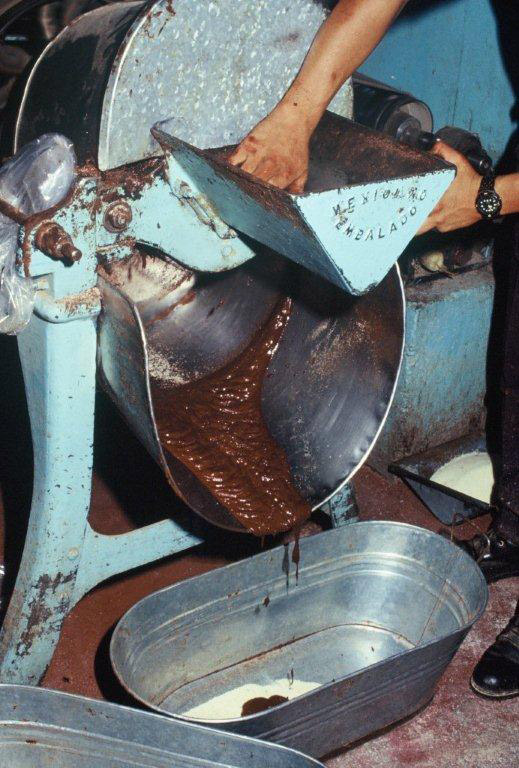
            The growth of chocolate-love took off with the invention of the grinding process in the mid-1700’s and its strong popularity in pre-revolutionary New England in 1765. While chocolate as a beverage spread everywhere, the first solid eating chocolate came in 1830 with the capacity to squeeze out cocoa butter as the basis of the resulting “liquor” which could then be molded, extruded and pressed into an endless range of forms.  The addition of sugar and other flavorings introduced by the Spaniards much earlier further enhanced the invention and eventual ubiquity of the candy bar revolution which gave birth to dozens of American manufacturing “empires”, from Hershey to Curtis.  (Cadbury and Lindt are dominant in worldwide chocolate statistics, and Germany, Austria, Switzerland and Ireland far outdistance the U.S. in annual consumption rates).
            To this day in Mexico, chocolate is seen as a basic food rather than a confection. While traveling and staying in Puebla, I was treated to a traditional mole Poblano featuring unsweetened chocolate as a chief ingredient, along with turkey meat, ground peanuts and raisins, ten varieties of chili peppers and a dozen other flavor-setters.
            Today, anyone and everyone can enjoy an eating/drinking pleasure which for tens of centuries could be served only to royalty and aristocrats.

Photo Caption No. 1    Cacao beans are allowed to ferment (cure) before being roasted and ground into a powder.  In ancient times a handful of “nibs” like this one might have paid taxes or purchased valuable goods.

Photo Caption No. 2    From roasted beans to cocoa powder to solid chocolate, cacao’s journey reaches back into more than 2000 years of history and culture. Dutch-processed cocoa pictured here differs in darkness and acidity following treatment with a potassium carbonate solution.

Photo caption No. 3     Visiting a chocolate shop in Oaxaca, Al Cooper was able to observe cacao paste being blended with such flavorings as vanilla, raw sugar and almonds in small batches as chosen by individual patrons. The finished product would be poured into molds and cooled before leaving the “do-it-yourself” establishment accompanied by the fragrance of cinnamon, ginger and crushed vanilla beans.
Photos by Al Cooper

CAPTURING U-505 - THE STORY THAT COULDN’T BE TOLD


Beginning with the knowledge of the ultimate outcome, it would be easy for a casual student of history to believe that the Allies were destined to win World War II and that Nazi Germany and the Axis powers would be defeated. What few Americans comprehend – even now – is the fact that right up into 1944, an Allied win was not a sure thing. One reason was the toll Nazi submarines were taking on Allied merchant shipping and the real possibility that with 40% of the war supplies she desperately needed going to the bottom month after month, England might not be able to hold out.
            In all, Nazi Germany launched 1174 submarines in the course of the war under the leadership of Admiral Karl DÓ§nitz, a genius in undersea warfare and an officer revered by his crews. With the fall of France, U-boats were conveniently deployed from protected “pens” at Ste.Nazaire and Lorient, where they could be outfitted for long-distance war patrols, both singly, and later in “wolf packs”.  By war’s end, they would sink nearly 4,000 Allied ships taking at least 36,000 sailors to the bottom with them in what is known as “The Battle of the Atlantic”.
            One of those U-boats (untersee boots) was the U-505, a type VII-C boat which carried a crew of about 60, and a war load of 24 torpedoes. In the German Navy as in those of other WWII nations, there were submarines which would be known as “lucky boats” to those who served aboard, and there would be those that earned the opposite reputation. Right from its launching in May 1941, U-505 would be an “unlucky boat”. Plagued by a series of mechanical failures and aborted missions, they just barely survived such a terrific mauling by Allied depth charges and aircraft attacks on their 4th patrol that they set a record as the most heavily-damaged U-boat to make its way back to port for repairs. As if things weren’t bad enough, their second Commanding Officer – dazed by constant undersea bombardment on the 10th patrol - went mad and shot himself in the head in the presence of his traumatized crew!
            Hoping to restore crew morale and stability, U-505 was deployed on its 12th patrol in late April, 1944 with a new and very experienced Commander, 41-year old Oberleutenant zur See Harold Lange., who, unfortunately, and through no fault of his own, was about to meet up with U.S. Navy Captain Daniel Gallery and his Task Group 22.3 off the coast of North Africa. With his Aircraft Carrier “USS Guadalcanal” and a squadron of specially trained destroyer escorts, Dan Gallery had set out to find, damage and capture an enemy U-boat intact, seaworthy and – most importantly – the secret German Naval codes which would be locked in the commander’s safe.
            The amazing story of how this wartime “coup” came about has been well and often written about, with several excellent television documentaries still current, and so I need spend little space on that part of the account.  There are however several side-bar stories worth revisiting. For one thing, there is much to admire in the decisions made by Captain Lange: with his boat forced to the surface and under heavy machine-gun fire from Gallery’s destroyers, he had only minutes to decide how to protect his craft’s secrets, honor his obligations as a German officer, and yet save the lives of his crew. He managed to do all of that, with the loss of only one life. On the other hand, Dan Gallery’s superbly-trained assault team managed to thwart the scuttling actions, secure the heavily-damaged U-boat and recover the secret German codes which – together with a captured “Enigma machine” - changed the course of WWII in the Atlantic.
            To me, as a passionate researcher and history buff, there remains a largely-untold and tantalizing side story.  For the purloined code book and other documents to be worth all the effort of planning, training and acts of courage involved, it was absolutely imperative that the whole thing be kept secret from the Germans, who must believe that the U-505 was simply “lost at sea with all hands”. For that creative fiction to be maintained, the 58 German officers and men had to be held in secret custody, their families unaware of their survival, while the three thousand U.S. sailors involved in Task Group 22.3 must remain silent until war’s end. That all of that took place is itself one of the remarkable stories of World War II.
            Ironically, as June 4th, 2012 dawns and I contemplate this article posted 67 years later to the day, I hold in my hands a document from the archives listing the names and postings of those 58 German submariners of U-505’s final patrol, along with pages from the carefully-kept personal diary of Oberfunkmaat (Signalman 1st class) Gottfried Fischer, the only man to lose his life that day.
            A FINAL NOTE:  U.S. Navy Admiral Daniel Gallery of Chicago, (1901 – 1977) and former German Navy Captain Harald Lange, of Hamburg, (1903 – 1967) remained friends throughout their lives. U-505 also lives on at the Museum of Science & Industry in Chicago, Illinois where it has been visited by millions. (Another story.)  The death rate for German submariners in WWII was 75%.  28,000 U-boat crewmen failed to return home from their final patrol.


Photo Caption:     Boarded and saved from sinking with minutes to spare by brave sailors of the Destroyer Escort U.S.S. Spillsbury, the foundering U-505, with American colors flying from the conning tower, is taken into tow for its long and secret voyage to Bermuda, on June 4th, 1944.              U.S. Navy Archives