Wednesday, February 5, 2014

1941 – COUNTDOWN TO INFAMY


As Japanese Ambassador to the U.S. Kichisaburo Nomora and his companion Saburo Kurusu, another “Peace Envoy” from the Emperor waited in the White House for an early morning meeting with Secretary of State Cordell Hull on December 7th, 1941, they were the only people in that building who did not know that an hour earlier, Pearl Harbor, Hawaii had been bombed by the country they represented. In fact – according to historian Eri Hotta - those somber-faced and dignified statesmen would not learn until en route back to their homeland several weeks later just how they had been “played” by their military leaders in Tokyo in order to insure the full “surprise” nature of the attack cast by President Roosevelt as the “day which will live in infamy”; (Thereby unintentionally giving the U.S. President the rallying call which would bring about the commitment of a reluctant America to “total war”.)

            Eri Hotta’s recently released book “JAPAN – 1941” reveals for the first time an intimate and comprehensive backstage look at the combination of ambition, self-delusion, Service rivalries, extreme factionalism between ministries and a profound absence of political courage which led Japan into a war they themselves believed was “unwinnable”. It will come as a surprise to many readers that among Japan’s highest echelons, there had been at least as much opposition to war with the U.S. as there was approval of the idea. For me, the biggest surprise was to learn that even Hideki Tojo – looked upon as the biggest “war monger” among them – had strong doubts, and was firmly against a “surprise” attack.  In the process she also focuses the spotlight of history on Washington’s not-insignificant role in missing many opportunities to postpone or even to avoid completely the necessity of fighting two simultaneous wars.

            Tokyo-born Historian Eri Hotta does not in any way come across as an “apologist” but in fact portrays the short-sightedness and chaotic, often dysfunctional picture of an Empire spinning out of control in 1941 with an honesty made the more impressive because of her unique credentials.

            Among factors not often considered by Allied critics – and obviously overlooked in the intelligence being presented in Washington in 1940-41 – was the immensity of the “Russia Problem” in the eyes of Japanese military and government leaders who had pressed for occupation of northern Manchuria and then the China invasion itself as a protective buffer. It was the fear of creeping communism which made the tri-partite agreement with Germany and Italy at first attractive to Tokyo. Later, with the quagmire which resulted from the China adventure impoverishing the homeland, Japan might have welcomed a chance to get out if presented with a way of “saving face” with their own Kwantung Army in the process.

            With an aggressive and expanding  military hierarchy  pressing a weak Prime Minister (Prince Konoe)  at home and America freezing their assets and imposing an embargo against oil and strategic metal shipments, against the background of an economically- pinched civil population, Japan chose  to carry out the conquest and occupation of Northern French Indo China (Viet Nam). With a total misreading of U.S. intentions and a miscalculation of the likelihood of a German victory in Europe, the Empire of Japan began to set in motion an increasingly irresistible slide toward war. Aware of a declining capacity to prevail in such a course, the momentum of this slide reached its tipping point with a series of government meetings in Tokyo setting November 26, 1941 as the date negotiations would end and the nation would be committed to war with the U.S..

            Ironically, it was Isoroku Yamamoto who more than any other Japanese leader opposed that war who would plan the Pearl Harbor attack, and a reluctant Emperor Hirohito – who was the only one who could have intervened to stop it – who received a “Peace Letter” from President Roosevelt three hours after it was too late to do so.

            In the final days of November, 1941 there were a dozen moments when a Pacific war could have been averted if a tiny handful of human beings on both sides had acted differently or more swiftly.


“Japan 1941 – Countdown to Infamy” presents one of the most important and far-reaching insights into the genesis of WWII in the Pacific extant today. (The Japanese flag in the background is an American G.I.’s hard-won memento of WWII campaigns stretching across the Pacific.)

Photo & Flag – Al Cooper


LINCOLN – GROWING INTO GREATNESS


It would be difficult to conjure a time and an environment less conducive to great accomplishment than a hard-scrabble farm cut from an encroaching forest, in Hardin County, Kentucky in the early years of the 1800s. It would later be said that if there was an underlying motivation in the life of Abraham Lincoln, it was a negative one: he did not want to be like his father. Thomas Lincoln, tall, sturdy of build and plodding through a difficult life, he was comfortably illiterate and seemingly content to cut trees, clear brush and eke out a bare subsistence for his wife and two children who shared a tiny one-room log dwelling in the best of times. Lincoln’s mother, who could read but not write introduced him to Bible lessons, and finally – and briefly -  to a local school at the age of six, where he learned to “cypher”, and was taught from Thomas Dillworth’s “New Guide to the English Tongue”, commonly known as “Dillworth’s Speller”, a book which would change Lincoln’s life.

            From the beginning, young Abe displayed an intuitive ability to master phonetics from written words on a page, and to thereafter be able to remember and recite aloud entire passages, whether from the ever-present family bible, or whatever written material came to hand.

            Life in Kentucky, and later in Indiana, was a continuation of economic poverty and personal loss for the family, as Lincoln’s mother died and was buried in a coffin fashioned by Thomas.  A year later, his father brought home  a new wife, the widow Sally Bush Johnston, a formidable woman who unpacked from her meager luggage “Arabian Nights”, Daniel DeFoe’s “Robinson Crusoe”, “Aesop’s Fables” and other volumes including John Bunyan’s “Pilgrim’s Progress”. Not only was Sally well-read, but she soon became the loving tutor young Abe would always credit for a positive turn in his life.

            His sister Sarah would later tell how as a young teenager her brother would climb upon a handy tree stump and proceed to tell stories, recite poetry and deliver persuasive speeches to his neighborhood friends. The word “persuasive” in fact would increasingly define Lincoln both in the written and spoken words which flowed from his proactive mind. He liked speaking, he liked writing, and he was a passionate reader. He enjoyed Milton, Byron and Gibbon and had a passion for Shakespeare and all his varied works, many of which he could quote flawlessly at the drop of a hat; and many “hats” dropped since those around him were endlessly entertained. Of all his beloved authors, I think his affection for the Scot Bobby Burns, with whom he felt an almost-mystical brotherhood, was supreme.

            Despite the ever-present need to earn money – splitting rails, building and floating barges down the rivers to New Orleans, tending a store, and failing as a retailer himself in the bargain – his thirst for knowledge and hunger for answers to life’s most pressing questions defined his days and nights. The practice of Law was thrust upon him, both by admiring friends and his own drive to move toward a sense of fulfillment. The Law did not come easily to him and his eventual success in that field was more a result of his common-sense approach to arguing his cases than a study of Blackstone and a “toolbox” of memorized precedents.

            As a legislator and candidate for public office though, he found his greatest platform for the practice of the fine art of rhetoric. In an age where few people could read or write let alone speak in public, his ability to shape and fine-tune every sentence to reinforce a crafted outcome swayed those who flocked to hear him. Mastering the combination of vocabulary, rhythm, balance and alliteration, he managed to make his opponents appear banal and ill-prepared. He was ever the consummate story-teller, with an innate ability to sense the mood and tenor of his audience and to capitalize on it with an economy of words; the five-minute-long Gettysburg Address an astounding example of Lincoln at his best.

            Besieged by a life-long tendency toward melancholy and sadness, bombarded by the ongoing loss of those he loved most in life, and then confronted with the most daunting challenge faced by any U.S. President, Lincoln remained committed to listening to “the better angels of our nature”, and staying true to core principles first absorbed from reading “Dillworth’s Speller” so many years before.


Worn down by two years of an ongoing war, Lincoln looks older than his 54 years in this daguerreotype made in 1863. Ineffably human, he hated to dress up and often displayed a certain pride in his sartorial indifference around the White House.


Thursday, January 30, 2014

GETTING UP STEAM ON THE MIGHTY MISSISSIPPI


There is no other sound quite as stirring as that of a steam-calliope, and even then no such instrument is guaranteed to send shivers up one’s spine quite like that of one on a Mississippi paddle-wheel steamer belting out the strains of “Dixie” and “Turkey in the Straw”. Recently - and not for the first time - I enjoyed that experience as I stood at the bottom of a New Orleans gang plank waiting to board the Steamboat Natchez for a cruise on the Mississippi River; the Mighty Mississippi!

            Everything about the “Big Muddy” is larger than life including the history and geography embraced by every one of its three-thousand-eight-hundred-and-sixty meandering miles from Canada to the Gulf of Mexico. Touching 10 states while draining the world’s 4th largest watershed (31 states and 2 Canadian Provinces), it is flowing at the rate of 600,000 cubic feet per second by the time it reaches New Orleans where it is over a mile wide and moving at a speed of 3.0 miles per hour.

            Beginning with the 1820s, travel on the Mississippi became synonymous with the evolution of steam power, with hundreds of side-wheelers and stern-wheelers vying for cargoes of grain, coal, cotton and passengers. These relatively-shallow-draft riverboats were well-suited to the challenge of navigating the constantly shifting mud flats and changing course of the river itself, and the “pilots” who handled the wheel were a breed apart. Mark Twain (Samuel Clemens) spent two years meticulously studying 2000 miles of the fickle Mississippi before qualifying as a river pilot, an experience which inspired his pen name and set the course of both his love for river boats and his writing career; “Cub Pilot”, a memoir of those years became his first publication.  

            Connecting the lands of the Louisiana Purchase with the sea and the world beyond made the port of New Orleans one of the world’s busiest and most important. The waterway itself was a target of the British in the War of 1812, and it was the loss of its control by the Confederacy that made an ultimate Northern victory a near certainty in the Civil War.

            As we made our way upriver on the steamship Natchez – actually the 9th riverboat to inherit that proud name – I wandered from a preferred seat in the very bow, through the grand salon where a 6-piece “Dixieland” Jazz band was playing and out to the stern where I could look down at the churning 26-ton paddlewheel with its 25 square feet of white oak and steel. Under my feet the steady beat of the massive  reciprocating steam engine which drove us gave no more than a hint at the 1600 horsepower being generated the real, old-fashion way. The boiler room itself is home to twin boilers, named “Thelma” and “Louise” which have been serving since 1925. Altogether it is hard to believe that weighing in at 1384 gross tons with a passenger capacity of 1200 we draw a draft of only six feet.

            In the beginning of river travel, it was those boilers and the yet-to-be-perfected system of steel plates and riveted seams that brought about all-too-frequent disasters on the Mississippi. During a 40-year period in the mid-1800s, 4,000 people lost their lives as more than 500 vessels went to the bottom following explosions. Mark Twain himself witnessed one of these onboard the “Pennsylvania” in 1858, as a sad consequence of which his brother, Henry Clemens died of his burns. Of this Twain wrote, “The star of my hope went out”.

             Most notable of all of these firey disasters was the loss of the steamboat “Sultana” which exploded and sank on April 27th, 1865 with a loss of 1800 lives – the greatest maritime disaster in American history – most of them Union Army soldiers recently released from Confederate prisons such as the infamous Andersonville. As the St. Louis-bound boat made a stop for boiler repairs at Vicksburg, more than 2000 swarmed their way onboard a vessel with a legal capacity of only 376. Ironically, this event didn’t get much media coverage inasmuch as all America was consumed with the news of the death of President Lincoln’s assassin, John Wilkes Booth the night before.

            For years, survivors of this tragedy met together annually with a promise to “never forget”. The last of these, Samuel H. Raudebaugh, Company K, 65th Ohio Infantry Regiment died in December, 1931 at the age of 89, having previously survived the battle of Franklin and the prison camp at Andersonville.


The Paddlewheel Steamer “Natchez” is one of several present-day reminders of an 80-year history of steam power on the Mighty Mississippi.


Sunday, January 26, 2014

THE GIFT OF WINGS AND WONDER


            It was during a semi-annual business lunch in Montreal with a Swiss associate that I found myself bemused by his true story of an animal encounter which had changed his life. He described how he and his young wife had been sun-bathing on the beach while vacationing on the French Riviera when their somnolence was broken by someone kicking sand in their faces. It turned out not to be “someone” but “something”; in this case a black and white Magpie displaying an obviously broken leg from which hung the remnants of a once-carefully-taped set of wooden splints. After they had repaired the device, the grateful bird followed them to their quarters, refusing to leave. Clearly, it had known human companionship, but my friends were unsuccessful in locating its owners. And so, having been “adopted” by the patient, they took it home with them to Switzerland where it ended up sharing their kitchen, dining table, bedroom and life. Each morning the Magpie would awaken my friend by gently opening his eye with its beak to peek inside. It had a place at their table and in their hearts while displaying a personality – and a gift for language – which were endearing. Its sense of humor though could be daunting at times, especially when left alone with my friend’s petite wife, upon whom the Magpie delighted in practicing a well thought-out naughtiness, purposely tipping over glasses of water, bowls of bread flour, and then mocking her with its haughty laughter from some safe perch.
            Along with crows and ravens, the magpie is a member of the corvidae family, a group of birds possessing a brain representing a weight larger than that of a human when expressed as a percentage of the animal’s total body weight. The forepart of that unique brain is believed to account for its capacity to remember, reason, access past lessons and even mimic the voices and behaviors of other animals and humans. After generations of living alongside humans, corvids have adopted seven key human characteristics according to John Marzluff and Tony Angell who write on the subject: They are language, insight, frolic, passion, wrath, delinquency, risk-taking, and awareness. Their ability to survive severe environmental conditions and abrupt changes in weather and food supply reflects their willingness to share resources and cooperate between groups and individuals, (a virtue humans might do well to emulate). Their complex societies display a commitment to monogamy – they mate for life, although adults who have both lost a mate may tie the knot again – show great devotion to each other and family, and grieve over death.
            Over and over again we see evidence that crows, ravens and magpies have learned to read human behavior and anticipate our actions. As a young boy, I learned that when armed with my .22 rifle, the crows behind our barn scattered at the sight of me, although if all I carried was a walking stick of similar general appearance, I could walk to within a stone’s throw.
            Inda Drakborg of Sweden became accustomed to throwing feed to the Ravens who rang her doorbell each morning when she was home alone. At other times her angry husband Abbe cursed and threw stones at them. Ready to go to work Abbe would find the windshield of his Mercedes plastered in white, runny excrement. When he traded parking places with his wife, his windshield would still get white-washed, while Inda’s Volvo was untouched.
            A clear case of avian “delinquency” plagued National Park rangers at a campground deep in Washington State’s Cascade Mountains when it was discovered that “someone” was removing the rubber inserts from vehicle windshield wipers. The culprit turned out to be a raven named “Hitchcock” and his mate. The hoped-for cure is still being measured, since similar thefts have been detected as far away as Alaska, New Brunswick and Yosemite in California.
            One of the most impressive experiments into a corvid’s ability to problem-solve and engage in “tool-making” involved placing a transparent, deep and narrow glass tube where a crow named Betty could see food in a tiny bucket with a handle, well out of reach in its bottom. A piece of straight wire was left within Betty’s reach. When still unable to extract the tidbit, the crow used one foot and its beak to create a hook at one end of the wire, which she was then able to use to snare the basket and lift it out.
            All science aside, high on the list of my “100 favorite things” – right up there with soft cotton socks and maple syrup pancakes -- is “the sound of crows on a frosty morning”, an aural phenomenon which never fails to harken back to my carefree days as a Vermont farm-boy.


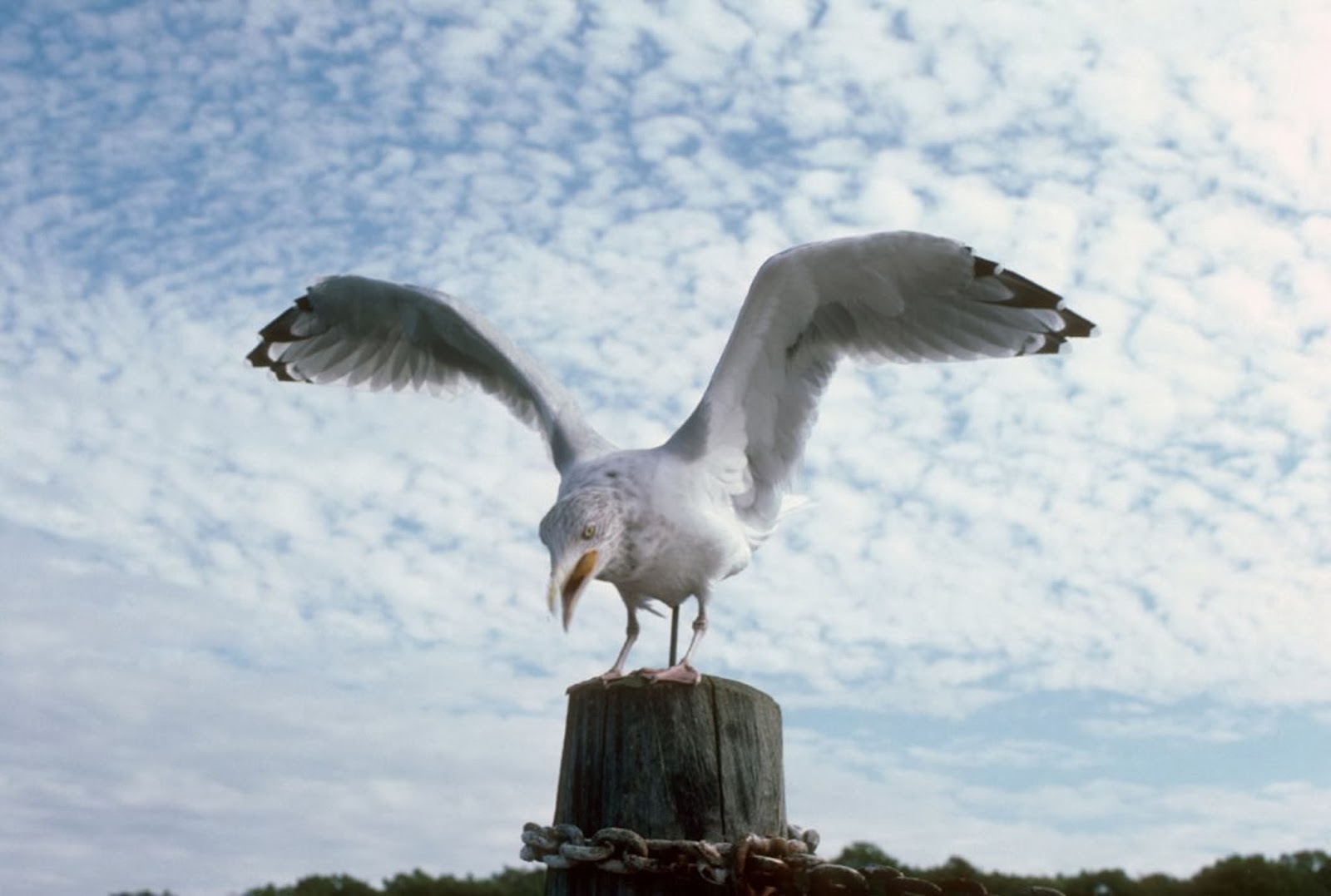
The author’s purloined French fry clutched in its mouth, a brazen Herring Gull exhibits the adaptability which permits certain birds to thrive on their close relationship with human society.
Al Cooper Photo

Tuesday, January 14, 2014

MARKING THE DEATH OF AN ENEMY SOLDIER


            In the course of a year, I probably write something like 250,000 words of serious copy, between this column, scripts for my radio program and a blog site which is visited by followers in ten countries at last count. None of this is done for real profit (not that I wouldn’t welcome such a boon), but because of my love for the written word and an unending sense of wonder as I look through the window of history. That said, it is easy for me to answer a frequently-asked question: “What do you think is the most personally important thing you have ever written?” The response always brings me back to a manuscript for a reading I do in person titled “IN THE COMPANY OF HEROES”, usually against a subdued musical background soundtrack of “Bring Him Home” from “Les Misérables”, and “Hymn to the Fallen” from “Saving Private Ryan”. It reflects a deeply-personal and heartfelt affinity for all those who have died, or been willing to die in the service of country and freedom. It is a theme which often shows through in the subject matter I touch upon, and for which I offer no apology.

            I am reminded of all this as I write today on the occasion of a little-celebrated and historically-overlooked event which took place exactly 199 years ago on a swampy piece of farmland seven miles down-river from New Orleans.

            The War of 1812 does not claim very many pages in today’s history books, and I don’t suppose the average high school student of our time could answer many questions on the subject. While it is a war we technically “won”, it was at least an unwise conflict for The United States to precipitate, and very unpopular among much of the country at the time. In fact, the most that can really be said of it is that we didn’t lose! And of course, it gave us our national anthem during the battle for Baltimore in 1814. To place it in a larger perspective, I would posit that it was actually the final battle of the American Revolution, which in the mind of the British anyway, had never really ended. It can also be said that since its conclusion, Great Britain and the United States have been the world’s closest friends and allies.

            To get back to the battlefield; having failed to realize any real victory by burning our nation’s capital, humiliating President Madison in the process, and bombarding Baltimore harbor without making good an invasion there, Admiral Sir Alexander Cochrane proposed to finish the upstart Americans off by taking the Port of New Orleans and thereby winning control of the Mississippi River and its access to the country’s interior, where they hoped to “undo” the Louisiana Purchase.

            Characteristically, the British plan for the taking of New Orleans was ambitious, complicated and reflective of a high degree of military hubris. With a commanding fleet of warships and experienced seamen and 18,000 well-trained soldiers, the campaign seemed well in hand. To begin with though, the construction of a canal which it was hoped would undermine the American defensive position went awry, and the anticipated line of fire for their cannon batteries proved untenable. Then too, they had no idea that a “backwoods” General named Andrew Jackson with his small force of 4,000 militiamen and local volunteers were waiting for them at Chalmette Plantation behind hand-built earthworks and a natural canal. Then at the height of the geometrically-perfect attack across all that open ground, the early morning fog which covered the advancing lines of British regulars in their bright red uniforms mysteriously and suddenly lifted and Jackson’s practiced squirrel hunters and 16 cannons loaded with grapeshot took a terrible toll. At the head of that attacking line rode Major General Sir Edward Pakenham, member of Parliament and perhaps the most talented and experienced of all His Majesty’s finest, a wounded and decorated veteran of a dozen military campaigns against a host of England’s enemies. Riddled with grapeshot and with his horse shot out from under him, he attempted to rally his troops before a second wounding proved fatal. With all of their officers dead or wounded, the British soldiers seemed to stand confused as more Colonial fire further reduced their numbers before a numbed Commander called retreat.

            With only 13 of his defenders killed against British casualties approaching 2,000, Major General Andrew Jackson not only brought the War of 1812 to an end (negotiations at Ghent had already concluded), but was on his way to becoming his country’s 7th President. Great Britain had not only suffered a battlefield defeat, but one of England’s most famous families had lost a much-loved son and one of the country’s most promising young soldier/leaders in a faraway land.


Born at Tullynally Castle in Ireland, Major General Sir Edward Pakenham, 3rd Baron Longford was 37 years old when he died in the Battle of New Orleans, the victim of “Old World” tactics ill-suited to combat in the “New World”.


Saturday, January 4, 2014

WAR PATROL- REMEMBERING THE MEN OF AMERICA'S "SILENT SERVICE"


As the USS Gudgeon, SS-211 nudged its way out of Pearl Harbor, Hawaii the morning of December 11, 1941, smoke was still curling skyward from the wreckage strewn along “battleship row” and American dead were still being counted.  Just three days into World War II for the United States and skipper Lt. Commander Elton W. Grenfell and the crew of the Tambor class submarine Gudgeon were setting course for the Japanese home islands, more than 3700 nautical miles away, with orders to wage “unrestricted warfare” against the Empire of Japan. Only a small handful of people knew that this 307-foot- long undersea craft manned by an all-volunteer crew made up of the youth of the Great Depression was the country’s first offensive action against a cruel enemy in a war destined to last more than four long bloody years. Three-and-a-half months before the Doolittle raiders carried out their token raid on Japan, U.S. submarines Gudgeon, Plunger (SS-179) and Pollack (SS-180) were successfully hunting maritime victims in Japanese home waters.

            While U.S. submarines played only a limited role in the Battle for the Atlantic, the opposite was true in the Pacific beginning in those very early days. While great naval surface battles and aerial warfare above would dominate the headlines in the months and years to come, a relatively small force of dedicated men would be fighting a lonely but deadly battle in the “silent service”. Their number would never exceed 1.6% of the U.S. Naval forces engaged, yet they would account for more than 55% of the losses inflicted upon the Merchant and Naval forces of the Empire of Japan while making it possible for the U.S. to take the offensive in the vast Pacific which strategically ought to have been a Japanese- controlled “lake”. In fact six out of every ten enemy merchant ships sent to the bottom would fall prey to American undersea warriors, operating at distances and under conditions unimagined by many of the world’s most brilliant pre-war admirals.

            It has always been disappointing to me after a lifetime of study and admiration on a personal level to note how little attention and patriotic pride has been focused on our nation’s WWII submariners and their incredible contribution to victory in the Pacific. With the undeniable help of intelligence provided by “Magic” – the top secret code-breaking operation which made possible the Allied “miracle” at Midway – a handful of American subs with names like Bowfin, Cod, Drum, Ling and Skate were wreaking havoc on Japanese shipping, denying supplies and replacements to an island empire stretching over thousands of square miles of ocean, and causing the enemy to curtail or displace entire manufacturing industries.

(In 1945, not so much as one ounce of sugar reached the Japanese homeland and oil and petroleum products dwindled to a trickle, with artificial gasoline made from potatoes becoming a stark option.)

            As aware as I am of the impressive statistics of defeat and victory, it is the image of young Americans living under the most challenging of daily conditions, enduing the trauma of depth-charges and aerial attack and the constant threat of a watery grave just a half-inch of steel skin away that haunts me.  I picture the entire crew of Silversides (SS-236), one of the most high-scoring boats of WWII, departing Brisbane harbor, its crew proudly lining the decks, wearing their jaunty “Digger” hats and singing “Waltzing Matilda” as they undertook one more war patrol. On that storied boat it was a young pharmacist mate named Tom Moore, trained to treat colds and boils, who used kitchen cutlery and medicinal whiskey to remove the gangrenous appendix of a shipmate as the skipper kept the submerged sub steady, a thousand miles from any kind of real medical help. His work was good enough that his patient George Platter was back “on shift” six days later.

            And I think of the Gudgeon which had gone to war as America’s first “spear-carrier” back in December 1941, and then mysteriously disappeared after the beginning of its 12th war patrol in April, 1944, after accumulating a success score almost without parallel. The proud fighting boat and her 78-man crew were reported “unheard from and assumed lost” a month later; and then virtually forgotten by everyone except the families back home who were left wondering. Not until 2006 would the mystery of its fatal bombing attack off the coast of Iwo Jima be confirmed by author Mike Ostland, the nephew of a Gudgeon crew member, and whose “Uncle Bill” he had never gotten to know in life.

            Fifty-two of America’s WWII submarines did not return from their final patrols, and 28% of those who served in the Silent Service were lost – the highest percentage of any combat unit serving in World War II.
 
 
The U.S.S. Silversides, SS-236 survived WWII, and is today a museum open to the public at 1346 Bluff St., Muskegon, Michigan. With an amazing war record, she became known as “The Lucky Ship”. There are 15 WWII submarines maintained for the public around the U.S. today.
Photo courtesy U.S. Naval Museum Assoc.